
Contents
Overview
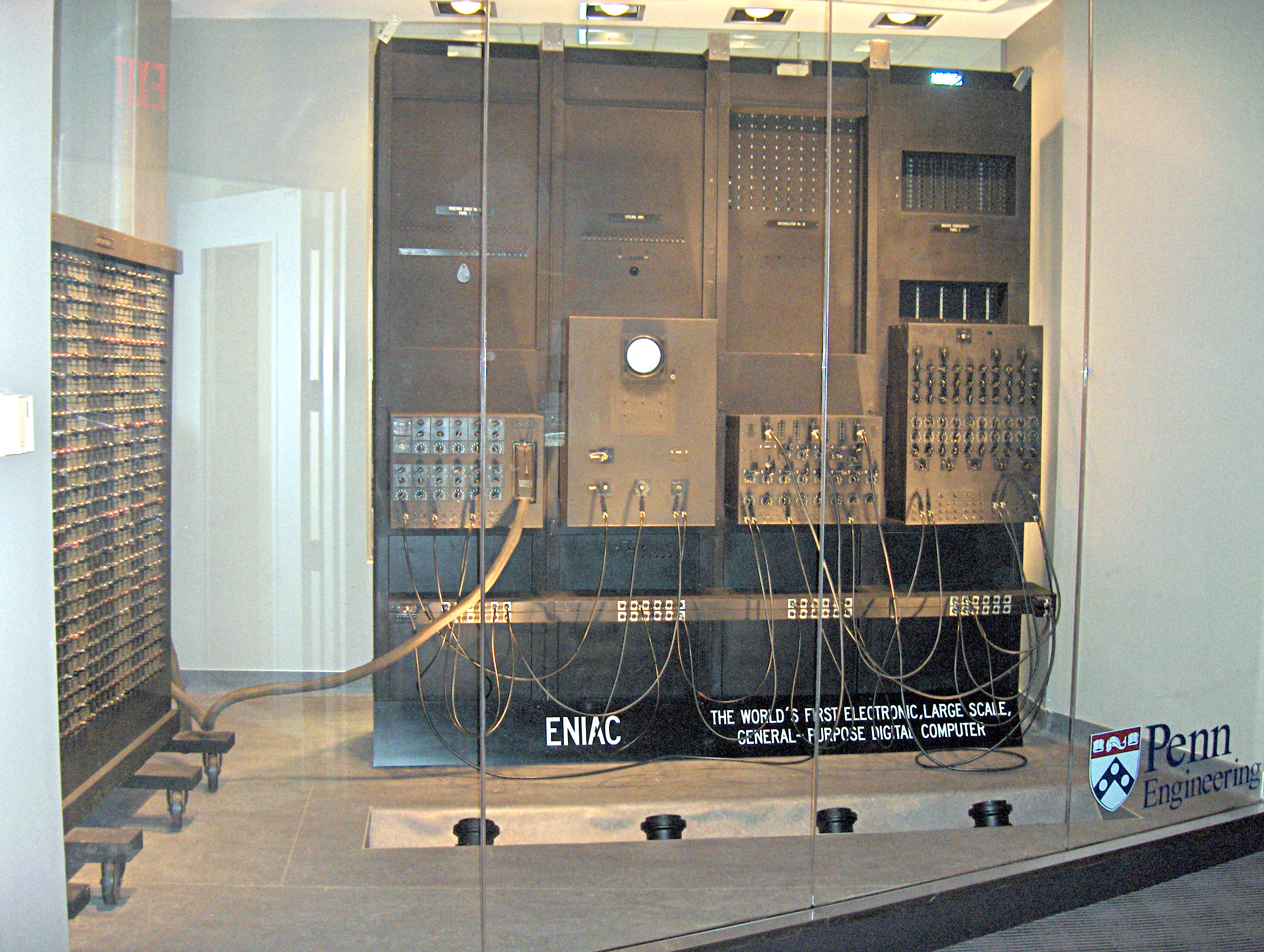
The genesis of ENIAC, the Electronic Numerical Integrator and Computer, can be traced to the urgent demands of World War II. Spearheaded by John Mauchly and J. Presper Eckert, its development was funded by the United States Army's Ballistic Research Laboratory (BRL) to address the laborious task of calculating artillery firing tables. The project officially began in 1943, with the machine being completed in 1945 and formally dedicated on February 15, 1946. While its primary purpose was military, its initial programming was dedicated to a study on the feasibility of the thermonuclear weapon, showcasing its broader computational potential beyond ballistics. Its sheer scale and complexity represented a quantum leap from earlier calculating devices, setting a new benchmark for what a computer could achieve.
⚙️ How It Works
ENIAC operated on a fundamentally electronic principle, utilizing approximately 17,468 vacuum tubes for its logic operations, along with 7,263 relays, 1,500 relays, and 70,000 resistors. Unlike modern computers that store programs in memory, ENIAC was programmed by manually setting switches and plugging cables into a vast switchboard, a process that could take days for complex tasks. It employed a decimal system rather than binary, a design choice that distinguished it from later machines. Its architecture was modular, with different units responsible for functions like input, output, arithmetic, and control, allowing for a degree of flexibility in its operation and problem-solving capabilities, though reprogramming was a physically intensive endeavor.
📊 Key Facts & Numbers
The sheer scale of ENIAC is staggering: it occupied 1,800 square feet of floor space, weighed approximately 30 tons, and consumed around 150 kilowatts of power. During its operational peak, it could perform approximately 5,000 additions, 357 multiplications, or 38 divisions per second, a speed that was roughly 1,000 times faster than contemporary electromechanical calculators. The cost of its construction reached $487,000, a sum equivalent to over $7 million in 2024 dollars. ENIAC's operational lifespan spanned from 1946 until its decommissioning in 1955, during which it reportedly performed over 100,000 calculations, demonstrating its immense utility and the dawn of a new era in computational power.
👥 Key People & Organizations
The intellectual architects behind ENIAC were John Mauchly and J. Presper Eckert, who led the engineering team at the University of Pennsylvania. Mauchly, a physicist, and Eckert, an electrical engineer, were instrumental in conceptualizing and realizing this ambitious project. The United States Army, through its Ballistic Research Laboratory, provided the crucial funding and the primary application for the machine. Key figures in its operation included the women known as "computers" who meticulously programmed and operated the machine, such as Kay McNulty, Betty Holberton, and Ruth L. Teitelbaum, whose contributions were vital to its functionality.
🌍 Cultural Impact & Influence
ENIAC's impact on the trajectory of technology and society cannot be overstated. Its successful development and operation demonstrated the viability of large-scale electronic computation, directly influencing the design of subsequent computers like the UNIVAC I, also developed by Eckert and Mauchly. The "Giant Brain" moniker, bestowed by the press, captured the public's imagination and fueled interest in the burgeoning field of computing. Its existence proved that complex numerical problems could be tackled with unprecedented speed, paving the way for advancements in science, engineering, and military strategy, and fundamentally altering the landscape of information processing and automation.
⚡ Current State & Latest Developments
While ENIAC itself was decommissioned in 1955, its legacy continues to resonate. Modern computing, from the personal computers on our desks to the smartphones in our pockets, owes a direct lineage to the principles ENIAC pioneered. The ongoing evolution of artificial intelligence and big data analytics can be seen as distant descendants of the computational power first unleashed by ENIAC. Although no longer operational, its physical components and historical significance are preserved, serving as a tangible reminder of the early days of digital computation and the relentless pursuit of faster, more capable machines.
🤔 Controversies & Debates
One of the primary controversies surrounding ENIAC relates to its claim as the "first" electronic general-purpose computer. While ENIAC was indeed the first to combine all these attributes in a practical, operational machine, earlier theoretical concepts and partial implementations existed. For instance, Konrad Zuse's Z3 (1941) was a programmable electromechanical computer, and the Atanasoff-Berry Computer (ABC) was an early electronic digital computer, though not general-purpose or programmable in the same way. The debate often centers on the precise definitions of "programmable" and "general-purpose," with some historians arguing that ENIAC's programming method was cumbersome and that other machines had prior claims to certain aspects of its functionality.
🔮 Future Outlook & Predictions
The future outlook for ENIAC is primarily one of historical preservation and educational inspiration. While the machine itself is a relic of the past, the principles it embodied continue to evolve at an exponential rate, as predicted by Ray Kurzweil's Law of Accelerating Returns. The quest for greater computational power, miniaturization, and efficiency that ENIAC initiated is now driving advancements in quantum computing and neuromorphic chips. The lessons learned from ENIAC's design and limitations continue to inform the development of more robust, user-friendly, and powerful computing systems for the challenges of tomorrow, from climate modeling to advanced medical research.
💡 Practical Applications
ENIAC's primary practical application was the calculation of complex mathematical tables, most notably artillery firing tables for the U.S. Army. This involved solving systems of differential equations that were crucial for accurate targeting during wartime. Beyond ballistics, its immense computational power was applied to studies of weather prediction and the feasibility of the thermonuclear weapon, demonstrating its versatility. Even after its military service, it was used for scientific research, including calculations for the Los Alamos National Laboratory. Its ability to perform rapid calculations was a significant boon for scientific and engineering endeavors that were previously intractable due to computational limitations.
Key Facts
- Category
- technology
- Type
- technology