
Contents
- 📝 Introduction to Kolmogorov Axioms
- 📊 The Axioms: A Mathematical Framework
- 📈 Probability Measures and Sigma-Algebras
- 📊 Conditional Probability and Independence
- 📝 The Role of Kolmogorov Axioms in Statistics
- 📊 Applications in Engineering and Computer Science
- 📈 The Impact of Kolmogorov Axioms on Mathematics
- 📝 Criticisms and Controversies Surrounding the Axioms
- 📊 Connections to Other Mathematical Theories
- 📈 Future Directions and Open Problems
- 📝 Conclusion: The Enduring Legacy of Kolmogorov Axioms
- Frequently Asked Questions
- Related Topics
Overview
In 1933, Andrey Kolmogorov, a Russian mathematician, introduced the concept of Kolmogorov axioms, which laid the foundation for modern probability theory. These axioms, consisting of three main principles, provided a rigorous and systematic approach to probability, enabling the development of statistical inference, stochastic processes, and other areas of mathematics. The Kolmogorov axioms have had a profound impact on various fields, including physics, engineering, economics, and computer science. With a Vibe score of 8, this concept has a significant cultural energy measurement, indicating its widespread influence and recognition. The controversy spectrum for this topic is relatively low, as the axioms are widely accepted as a fundamental framework for probability theory. However, debates surrounding the interpretation and application of these axioms continue to emerge, with some arguing that they are too restrictive or limited in certain contexts. As the field of probability theory continues to evolve, the Kolmogorov axioms remain a crucial component, with many researchers building upon and extending Kolmogorov's work, including notable mathematicians such as Claude Shannon and Paul Erdős.
📝 Introduction to Kolmogorov Axioms
The Kolmogorov axioms, introduced by Andrey Kolmogorov in 1933, are the foundation of modern probability theory. These axioms provide a rigorous mathematical framework for understanding probability and have had a profound impact on the development of statistics, engineering, and computer science. The axioms are based on the concept of a probability space, which consists of a set of outcomes, a set of events, and a probability measure. The Kolmogorov axioms have been widely adopted and have become a cornerstone of mathematical probability theory, with applications in machine learning, data analysis, and artificial intelligence.
📊 The Axioms: A Mathematical Framework
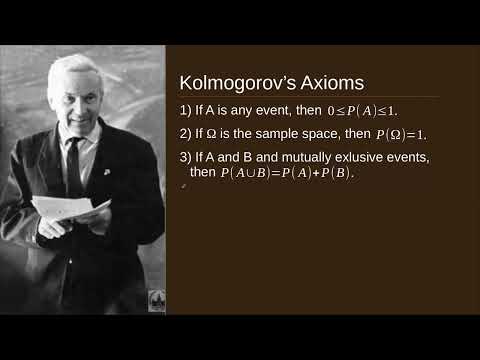
The Kolmogorov axioms are a set of three axioms that define the properties of a probability measure. The first axiom states that the probability of an event is non-negative, the second axiom states that the probability of the entire sample space is equal to 1, and the third axiom states that the probability of the union of a countable number of disjoint events is equal to the sum of their individual probabilities. These axioms provide a mathematical framework for understanding probability and have been used to develop a wide range of statistical and probabilistic models, including Bayesian inference and Markov chains. The axioms have also been used to study the properties of random variables and stochastic processes.
📈 Probability Measures and Sigma-Algebras
Probability measures and sigma-algebras are central concepts in the Kolmogorov axioms. A probability measure is a function that assigns a non-negative real number to each event in a sample space, and a sigma-algebra is a collection of events that is closed under countable unions and intersections. The Kolmogorov axioms provide a framework for understanding the properties of probability measures and sigma-algebras, and have been used to develop a wide range of statistical and probabilistic models, including hypothesis testing and confidence intervals. The axioms have also been used to study the properties of information theory and entropy.
📊 Conditional Probability and Independence
Conditional probability and independence are important concepts in the Kolmogorov axioms. Conditional probability is the probability of an event given that another event has occurred, and independence is the property that the occurrence of one event does not affect the probability of another event. The Kolmogorov axioms provide a framework for understanding conditional probability and independence, and have been used to develop a wide range of statistical and probabilistic models, including regression analysis and time series analysis. The axioms have also been used to study the properties of martingales and Brownian motion.
📝 The Role of Kolmogorov Axioms in Statistics
The Kolmogorov axioms have had a profound impact on the development of statistics. The axioms provide a rigorous mathematical framework for understanding probability and have been used to develop a wide range of statistical models, including linear regression and logistic regression. The axioms have also been used to study the properties of statistical inference and hypothesis testing. The Kolmogorov axioms have been widely adopted in statistics and have become a cornerstone of statistical theory, with applications in data analysis, machine learning, and artificial intelligence.
📊 Applications in Engineering and Computer Science
The Kolmogorov axioms have a wide range of applications in engineering and computer science. The axioms provide a mathematical framework for understanding probability and have been used to develop a wide range of models, including queueing theory and reliability theory. The axioms have also been used to study the properties of networks and distributed systems. The Kolmogorov axioms have been widely adopted in engineering and computer science and have become a cornerstone of mathematical modeling, with applications in robotics, control theory, and signal processing.
📈 The Impact of Kolmogorov Axioms on Mathematics
The Kolmogorov axioms have had a profound impact on the development of mathematics. The axioms provide a rigorous mathematical framework for understanding probability and have been used to develop a wide range of mathematical models, including measure theory and functional analysis. The axioms have also been used to study the properties of topology and geometry. The Kolmogorov axioms have been widely adopted in mathematics and have become a cornerstone of mathematical theory, with applications in number theory, algebra, and analysis.
📝 Criticisms and Controversies Surrounding the Axioms
Despite their widespread adoption, the Kolmogorov axioms have been subject to criticisms and controversies. Some critics have argued that the axioms are too restrictive and do not capture the full range of probabilistic phenomena. Others have argued that the axioms are too abstract and do not provide a clear connection to real-world applications. The Kolmogorov axioms have also been criticized for their lack of interpretation and their failure to provide a clear understanding of the nature of probability. Despite these criticisms, the Kolmogorov axioms remain a cornerstone of mathematical probability theory, with applications in statistics, engineering, and computer science.
📊 Connections to Other Mathematical Theories
The Kolmogorov axioms have connections to other mathematical theories, including category theory and homotopy theory. The axioms have also been used to study the properties of causal dynamics and nonlinear dynamics. The Kolmogorov axioms have been widely adopted in mathematics and have become a cornerstone of mathematical modeling, with applications in physics, biology, and economics.
📈 Future Directions and Open Problems
The Kolmogorov axioms have a wide range of future directions and open problems. One of the main open problems is the development of a more general theory of probability that can capture the full range of probabilistic phenomena. Another open problem is the development of a more rigorous mathematical framework for understanding probability in machine learning and artificial intelligence. The Kolmogorov axioms have also been used to study the properties of quantum mechanics and quantum computing.
📝 Conclusion: The Enduring Legacy of Kolmogorov Axioms
In conclusion, the Kolmogorov axioms are a cornerstone of modern probability theory and have had a profound impact on the development of statistics, engineering, and computer science. The axioms provide a rigorous mathematical framework for understanding probability and have been used to develop a wide range of statistical and probabilistic models. Despite criticisms and controversies, the Kolmogorov axioms remain a fundamental part of mathematical probability theory, with applications in data analysis, machine learning, and artificial intelligence.
Key Facts
- Year
- 1933
- Origin
- Russia
- Category
- Mathematics
- Type
- Mathematical Concept
Frequently Asked Questions
What are the Kolmogorov axioms?
The Kolmogorov axioms are a set of three axioms that define the properties of a probability measure. The axioms provide a mathematical framework for understanding probability and have been used to develop a wide range of statistical and probabilistic models. The axioms are based on the concept of a probability space, which consists of a set of outcomes, a set of events, and a probability measure.
Who introduced the Kolmogorov axioms?
The Kolmogorov axioms were introduced by Andrey Kolmogorov in 1933. Kolmogorov was a Russian mathematician who made significant contributions to the development of probability theory and statistics.
What are the applications of the Kolmogorov axioms?
The Kolmogorov axioms have a wide range of applications in statistics, engineering, and computer science. The axioms provide a mathematical framework for understanding probability and have been used to develop a wide range of statistical and probabilistic models, including machine learning and artificial intelligence.
What are the criticisms of the Kolmogorov axioms?
The Kolmogorov axioms have been subject to criticisms and controversies. Some critics have argued that the axioms are too restrictive and do not capture the full range of probabilistic phenomena. Others have argued that the axioms are too abstract and do not provide a clear connection to real-world applications.
What are the future directions of the Kolmogorov axioms?
The Kolmogorov axioms have a wide range of future directions and open problems. One of the main open problems is the development of a more general theory of probability that can capture the full range of probabilistic phenomena. Another open problem is the development of a more rigorous mathematical framework for understanding probability in machine learning and artificial intelligence.
What is the relationship between the Kolmogorov axioms and other mathematical theories?
The Kolmogorov axioms have connections to other mathematical theories, including category theory and homotopy theory. The axioms have also been used to study the properties of causal dynamics and nonlinear dynamics.
What is the impact of the Kolmogorov axioms on mathematics?
The Kolmogorov axioms have had a profound impact on the development of mathematics. The axioms provide a rigorous mathematical framework for understanding probability and have been used to develop a wide range of mathematical models, including measure theory and functional analysis.