
Contents
Overview
The genesis of the Cartesian coordinate system is inextricably linked to the 17th-century French philosopher and mathematician René Descartes. While Descartes is widely credited with its formalization in his 1637 work La Géométrie, the concept of using numerical measures to locate points has earlier roots, with precursors found in the work of Nicole Oresme in the 14th century and Apollonius of Perga's work on conic sections. Descartes' genius lay in unifying geometry and algebra, demonstrating how geometric shapes could be described by algebraic equations and vice-versa. This fusion, known as analytic geometry, revolutionized mathematical thought, providing a powerful new method for solving complex problems and laying the groundwork for calculus and modern physics. The system's adoption was not immediate; it faced initial resistance and debate, but its utility in describing motion and physical phenomena, particularly by Pierre de Fermat and later Isaac Newton and Gottfried Wilhelm Leibniz, cemented its place in the scientific canon.
⚙️ How It Works
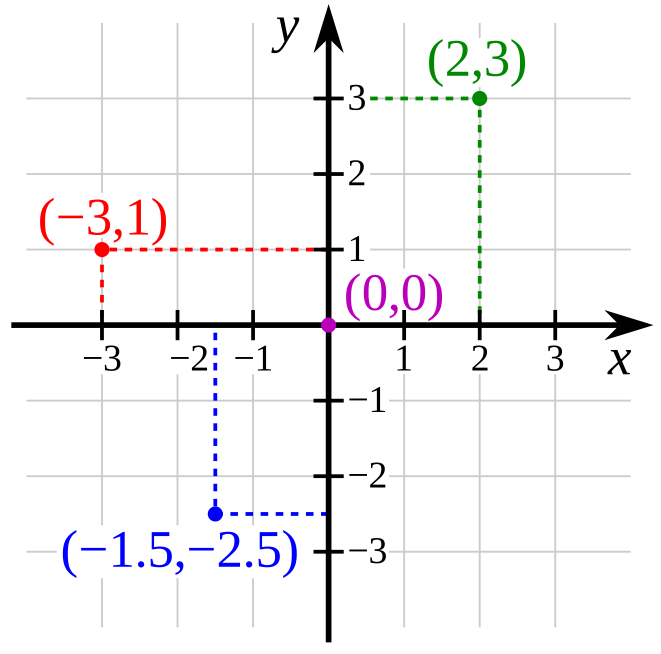
At its heart, the Cartesian coordinate system defines a point's position by its distances from a set of perpendicular axes. In a two-dimensional plane, these are the x-axis (horizontal) and y-axis (vertical), intersecting at the origin (0,0). A point is then represented by an ordered pair (x, y), where 'x' is the directed distance along the x-axis and 'y' is the directed distance along the y-axis. For three-dimensional space, a third z-axis is added, perpendicular to both x and y, creating an ordered triplet (x, y, z). This system provides a unique address for every point, allowing for precise geometric descriptions and calculations. The sign of each coordinate indicates which of the four quadrants (in 2D) or eight octants (in 3D) the point lies within, offering a comprehensive spatial mapping.
📊 Key Facts & Numbers
The Cartesian system is the bedrock for countless measurements and calculations. In 2D, over 100 million CAD drawings are created annually, all relying on Cartesian principles. In 3D printing, designs are translated into millions of coordinate points to guide the extrusion process. The global video game industry, valued at over $200 billion in 2023, uses Cartesian coordinates extensively for character positioning, object placement, and camera control. Even seemingly simple tasks, like navigating with a GPS device, which triangulates positions using satellite signals, ultimately translate these signals into a Cartesian framework for user display. The precision of a laser interferometer can measure displacements down to nanometers, a feat enabled by its ability to track points along Cartesian axes.
👥 Key People & Organizations
The intellectual titans behind the Cartesian system are René Descartes and Pierre de Fermat, who independently developed foundational aspects of analytic geometry in the 17th century. Descartes, the philosopher-mathematician, is most famously associated with the system's formalization and popularization. Fermat, a lawyer and amateur mathematician, also made significant contributions, particularly in developing methods that foreshadowed calculus. Later mathematicians like Leonhard Euler and Carl Friedrich Gauss built upon this foundation, integrating it into broader mathematical theories. In modern times, organizations like the International Mathematical Union and the National Science Foundation continue to support research that relies on and extends the principles of coordinate geometry.
🌍 Cultural Impact & Influence
The impact of Cartesian coordinates on culture and science is profound and pervasive. It provided the essential framework for Newtonian mechanics, enabling the description of planetary orbits and projectile motion with unprecedented accuracy. In art, artists like Piet Mondrian explored geometric abstraction, directly influenced by the grid-like structures inherent in Cartesian thinking. The development of computer graphics in the late 20th century, powering everything from animated films to virtual reality simulations, is fundamentally built upon the Cartesian grid. Even the layout of cities, with their often grid-like street plans, reflects an intuitive application of spatial organization that echoes Cartesian principles. The very concept of a 'map' as a scaled representation of space owes a debt to this system.
⚡ Current State & Latest Developments
While the core principles of Cartesian coordinates remain immutable, their application continues to evolve. In 2024, advancements in quantum computing are exploring how quantum states might be represented and manipulated using generalized coordinate systems, potentially extending beyond classical Cartesian frameworks. The field of computational geometry is constantly refining algorithms for handling massive datasets of points in high-dimensional spaces, far beyond the familiar 2D and 3D. Furthermore, the integration of AI and machine learning with geometric modeling, seen in platforms like NVIDIA's Omniverse, is creating dynamic and interactive environments where Cartesian spaces are not static but responsive and generative.
🤔 Controversies & Debates
Debates surrounding Cartesian coordinates often touch upon their limitations and philosophical implications. Some critics, particularly within phenomenology and embodied cognition studies, argue that the abstract, disembodied nature of Cartesian space can overlook the richness of lived, spatial experience. The philosophical problem of how abstract mathematical entities like coordinates relate to physical reality, a cornerstone of the philosophy of mathematics, remains a subject of discussion. Additionally, while immensely powerful, the Cartesian system can become computationally intensive in extremely high dimensions (the 'curse of dimensionality'), leading to research into alternative or complementary geometric representations for specific applications.
🔮 Future Outlook & Predictions
The future of Cartesian coordinates will likely involve deeper integration with higher-dimensional mathematics and AI. Researchers are exploring how to apply these principles to spaces with hundreds or even thousands of dimensions, crucial for fields like bioinformatics and machine learning where data points can have numerous attributes. The development of quantum geometry may offer new ways to describe reality at its most fundamental levels, potentially building upon or diverging from classical Cartesian structures. As virtual and augmented reality technologies become more sophisticated, the precision and efficiency with which Cartesian spaces can be rendered and interacted with will continue to be a critical area of innovation.
💡 Practical Applications
Cartesian coordinates are indispensable in countless practical applications. Engineers use them to design everything from airplanes to microchips, defining precise shapes and trajectories. Astronomers plot the positions of stars and galaxies using celestial coordinate systems derived from Cartesian principles. In medicine, medical imaging techniques like CT scans and MRI reconstruct 3D anatomical models from a series of 2D slices, all based on coordinate data. Financial analysts use multi-dimensional coordinate systems to model complex market relationships and predict trends. Even everyday software, from word processors to spreadsheet programs, utilizes underlying coordinate systems for layout and object placement.
Key Facts
- Category
- science
- Type
- topic