
Contents
Overview
The concept of Central Europe is less a fixed geographical boundary and more a historical and cultural construct, evolving over centuries of shifting empires and allegiances. Its roots can be traced to the early medieval period with the establishment of kingdoms like Poland and Bohemia, and the enduring influence of the Holy Roman Empire, which encompassed much of what is now Germany, Austria, and the Czech Republic. The Polish–Lithuanian Commonwealth, formed in 1569, represented a vast political entity that spanned large swathes of modern-day Poland, Lithuania, Belarus, Ukraine, and parts of Russia and Slovakia, fostering a unique multi-ethnic and multi-religious society. Simultaneously, the Ottoman Empire exerted significant influence in the south, particularly in Hungary and Croatia, while the Habsburg Monarchy gradually consolidated power over Austria, Bohemia, Hungary, and parts of the Balkans, shaping the region's destiny for centuries. The Enlightenment and subsequent nationalist movements in the 19th century further complicated and redefined Central European identity, leading to the formation of modern nation-states after World War I.
⚙️ Defining the Region
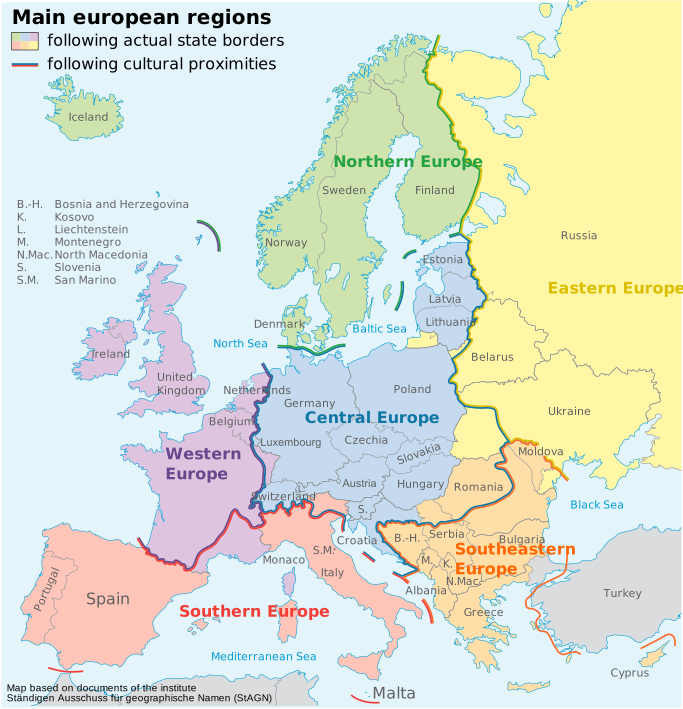
Defining Central Europe is an exercise in acknowledging its inherent ambiguity. Geographically, it occupies the heartland of the continent, a transitional zone where Western and Eastern European influences converge. Common definitions include Austria, the Czech Republic, Germany, Hungary, Poland, Slovakia, and Switzerland, though interpretations vary widely. Some scholars extend the definition to include Slovenia, Croatia, and even parts of the Baltic states like Lithuania, reflecting historical ties and cultural affinities. The region is characterized by a rich tapestry of languages—primarily Slavic (Czech, Slovak, Polish), Germanic (German), and Finnic (Hungarian)—and a shared history marked by periods of imperial dominance, intellectual ferment, and profound social change. The legacy of empires like the Habsburgs and the Prussian state has left an indelible mark on the political and cultural landscapes of these nations, fostering a complex relationship with both Western and Eastern Europe.
📊 Key Facts & Numbers
Central Europe is home to a significant demographic bloc within the European continent. The region boasts a substantial combined GDP, with powerhouse economies like Germany contributing significantly to this figure. Historically, it was the heartland of the Industrial Revolution in continental Europe, with nations like Germany and the Czech Republic pioneering advancements in manufacturing and engineering. The region is also a major player in the European Union, with 11 of its 27 member states located within or partially within Central Europe, including major economies like Germany and Poland. Furthermore, Central Europe is a significant destination for tourism, attracting a large number of international visitors annually, drawn to its historical cities, diverse landscapes, and rich cultural heritage. The average life expectancy across the region reflects advancements in healthcare and living standards.
👥 Key Figures & Powers
The historical narrative of Central Europe is inextricably linked to the rise and fall of powerful empires and influential figures. The Habsburg dynasty, ruling for over six centuries, profoundly shaped the political and cultural contours of Austria, Hungary, Bohemia, and beyond. Figures like Maria Theresa and Joseph II implemented sweeping reforms that modernized administration and society. The Prussian state, under leaders like Frederick the Great, emerged as a dominant force, particularly in German unification. In the east, the Polish–Lithuanian Commonwealth was a unique experiment in aristocratic republic, with figures like Jan III Sobieski playing pivotal roles in European history. Philosophers like Immanuel Kant in Königsberg (now Kaliningrad) and Edmund Husserl in Prossnitz (now Prostějov) shaped the intellectual landscape, laying groundwork for modern philosophy. After World War II, the region became a focal point of the Cold War, with figures like Lech Wałęsa leading resistance against Soviet influence.
🌍 Cultural Impact & Influence
Central Europe's cultural output has had a profound and lasting impact on the global stage. It is the birthplace of classical music giants like Wolfgang Amadeus Mozart in Salzburg and Frédéric Chopin in Warsaw, whose compositions remain cornerstones of the repertoire. The region's literary tradition boasts Nobel laureates such as Olga Tokarczuk and Henryk Sienkiewicz, whose works explore complex themes of identity, history, and human nature. Philosophically, thinkers like Karl Popper (born in Vienna) have shaped Western thought. The region's architectural heritage, from the Baroque splendor of Prague to the Art Nouveau elegance of Budapest, continues to inspire designers and architects worldwide. Furthermore, Central European cinema, exemplified by directors like Miloš Forman, has offered critical perspectives on society and politics, earning international acclaim.
⚡ Current State & Latest Developments
In the contemporary era, Central Europe is navigating a complex geopolitical and economic landscape. The region has largely embraced democratic governance and market economies following the collapse of Soviet Union influence in 1989. Many Central European nations are now integral members of the European Union and NATO, fostering closer integration with Western Europe. However, the region also faces challenges, including demographic shifts, varying levels of economic development, and ongoing debates about national identity and sovereignty. The rise of populist movements in countries like Hungary and Poland has sparked discussions about the future direction of democratic values and EU relations. Technological innovation is also a growing focus, with countries like the Czech Republic and Germany investing heavily in research and development, particularly in areas like automotive technology and advanced manufacturing, building on their industrial legacies.
🤔 Controversies & Debates
The very definition of Central Europe remains a subject of ongoing debate, reflecting its complex historical and geopolitical positioning. Some scholars and politicians argue for a more inclusive definition that acknowledges the historical and cultural ties of countries like Slovenia and Croatia, while others maintain a stricter, more geographically precise interpretation. The legacy of communism and the subsequent transition to democracy have also created divergent experiences and perspectives within the region, leading to discussions about shared versus distinct national identities. Furthermore, the region's relationship with both Western and Eastern Europe is a constant point of contention, with some advocating for closer integration with the West and others emphasizing unique regional characteristics and historical connections. The influence of external powers, historically and currently, also fuels these debates, as nations grapple with maintaining their autonomy and cultural distinctiveness.
🔮 Future Outlook & Predictions
The future of Central Europe is poised at a critical juncture, shaped by ongoing geopolitical realignments and evolving societal trends. Continued integration within the European Union is likely, though the extent of this integration and the balance of power within the bloc will remain subjects of negotiation. Economic development is expected to continue, particularly in sectors like green technology and digital services, building on the region's strong industrial base. Demographic challenges, including aging populations and emigration, wil
Key Facts
- Category
- culture
- Type
- topic