
Contents
- 🌀 What Exactly IS the Coriolis Force?
- 🌍 The Earthly Manifestation: Weather & Water
- 🚀 Beyond Earth: Spacecraft & Beyond
- 🤔 Is It Real? The Pseudo-Force Debate
- 💡 Historical Roots: From Water Wheels to Weather Maps
- ⚖️ Coriolis vs. Inertia: Understanding the Difference
- 📈 Measuring the Effect: Practical Applications
- ⚠️ Common Misconceptions & Clarifications
- Frequently Asked Questions
- Related Topics
Overview
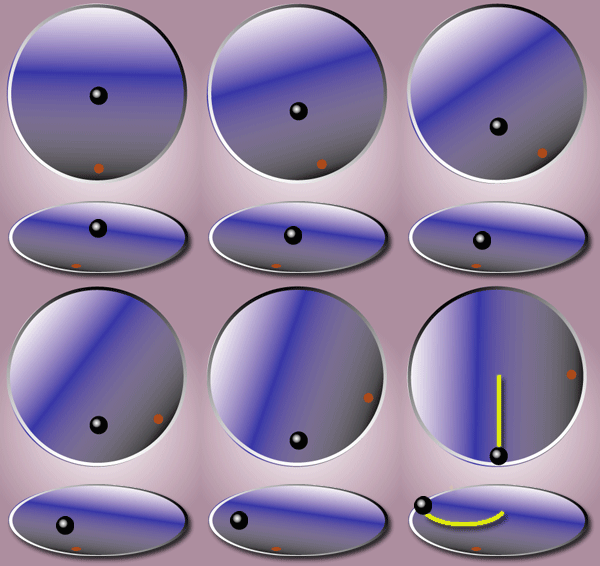
The Coriolis force isn't a true force in the Newtonian sense; it's a pseudo-force that arises because we often observe motion from a rotating frame of reference. Imagine trying to draw a straight line on a spinning merry-go-round – your line will appear curved to someone standing still. This apparent deflection, to the right in the Northern Hemisphere and to the left in the Southern Hemisphere, is the Coriolis effect. It's crucial for understanding large-scale phenomena, from the spin of hurricanes to the trajectory of long-range artillery. The mathematical formulation, first published by Gaspard-Gustave de Coriolis in 1835, helps quantify this deflection based on the object's velocity and the rate of rotation of the reference frame.
🌍 The Earthly Manifestation: Weather & Water
On our spinning planet, the Coriolis force is a dominant factor in meteorology and oceanography. It's why hurricanes and typhoons spin counter-clockwise in the Northern Hemisphere and clockwise in the Southern Hemisphere. Without this effect, air would simply flow directly from high to low pressure, creating a very different global weather pattern. Similarly, major ocean currents are shaped by this deflection, influencing climate and marine ecosystems across vast distances. Understanding this force is key to predicting weather patterns and navigating oceanic routes.
🚀 Beyond Earth: Spacecraft & Beyond
While most famously discussed in Earth-bound contexts, the Coriolis force is equally relevant in space. When launching rockets or maneuvering spacecraft, engineers must account for the Earth's rotation. Even in the vacuum of space, if a spacecraft is rotating, objects within it will experience Coriolis effects. This is particularly important for experiments conducted on rotating space stations or during complex orbital maneuvers where precise trajectory adjustments are critical. Ignoring it could lead to significant mission failures.
🤔 Is It Real? The Pseudo-Force Debate
The 'pseudo-force' label sparks debate: is it 'real'? From the perspective of an observer within the rotating frame (like a meteorologist on Earth), the Coriolis force feels real and causes observable deflections. However, from an inertial frame (an observer in space looking at Earth), there's no extra force; the object is simply continuing in a straight line while the Earth rotates beneath it. This distinction is vital for accurate physical modeling, though for practical applications on Earth, treating it as a force is highly effective.
💡 Historical Roots: From Water Wheels to Weather Maps
The story of the Coriolis force begins not with weather, but with industrial mechanics. Gaspard-Gustave de Coriolis first described the mathematical principles in 1835 while studying the efficiency of water wheels. It wasn't until the early 20th century that its significance in meteorology and oceanography became widely recognized. This evolution highlights how fundamental physics principles can find profound applications far beyond their initial context, reshaping our understanding of planetary systems.
⚖️ Coriolis vs. Inertia: Understanding the Difference
Inertia is the tendency of an object to resist changes in its state of motion. The Coriolis force is a consequence of observing motion from a non-inertial (rotating) frame. If you're on a train moving at a constant speed on a straight track, you're in a roughly inertial frame. If the train suddenly turns, you feel a force pushing you outward – that's inertia at play. The Coriolis force is similar but arises from the continuous rotation of your reference frame, causing a continuous apparent deflection of moving objects.
📈 Measuring the Effect: Practical Applications
Measuring the Coriolis effect directly on small scales is challenging due to its subtlety, but its impact is undeniable in large systems. In meteorology, tracking wind patterns and storm trajectories provides constant validation. In engineering, it's factored into the design of long-range artillery and missile systems to ensure accuracy. Even in the design of certain industrial machinery, like centrifuges, understanding rotational dynamics and potential Coriolis effects is crucial for optimal performance and safety.
⚠️ Common Misconceptions & Clarifications
A common misconception is that the Coriolis force causes water to drain in opposite directions in sinks or toilets. This is false; the scale is far too small for the effect to be noticeable. The direction of spin is determined by the shape of the basin and the initial motion of the water. Another error is attributing all rotational phenomena to Coriolis; many rotations are driven by direct forces or other factors, with Coriolis acting as a modifier on larger scales.
Key Facts
- Year
- 1835
- Origin
- France
- Category
- Physics
- Type
- Concept
Frequently Asked Questions
Does the Coriolis force affect toilets?
No, the Coriolis force is too weak to noticeably affect the direction water drains in sinks or toilets. The scale of these systems is minuscule compared to the planetary rotation that drives the Coriolis effect. The direction of spin in your drain is determined by factors like the shape of the basin and how the water is initially disturbed, not the Earth's rotation.
Why is it called a 'pseudo-force'?
It's termed a pseudo-force because it's not a fundamental force like gravity or electromagnetism. Instead, it's an artifact of observing motion from a rotating reference frame. From an inertial (non-rotating) perspective, the object is moving in a straight line, and it's the frame of reference that is moving underneath it. However, within the rotating frame, it appears as if a force is acting on the object.
How does the Coriolis force influence hurricanes?
The Coriolis force is fundamental to the formation and rotation of hurricanes. As air rushes towards a low-pressure center, the Coriolis effect deflects it. In the Northern Hemisphere, this deflection is to the right, causing the air to spiral counter-clockwise around the low. In the Southern Hemisphere, the deflection is to the left, resulting in a clockwise spin. This rotation is what gives hurricanes their characteristic structure.
Is the Coriolis force stronger at the poles or the equator?
The Coriolis force is strongest at the Earth's poles and weakest at the equator. This is because the effective rotation rate of the Earth's surface relative to the axis of rotation is greatest at the poles and zero at the equator. Therefore, large-scale atmospheric and oceanic movements are more significantly deflected at higher latitudes.
Can the Coriolis force be observed in everyday life?
While its effects are pervasive in large-scale systems like weather and ocean currents, the Coriolis force is generally too weak to be easily observed in everyday, small-scale phenomena. Attempts to demonstrate it with simple experiments like dropping objects from heights or observing water draining are often confounded by other factors and are not reliable indicators of the Coriolis effect.