
Contents
Overview
The Crisis of the Third Century didn't erupt from a vacuum; it was the culmination of simmering pressures within the Roman Empire. The preceding Severan dynasty, while stabilizing the empire for a time, had relied heavily on military might and increased taxation, sowing seeds of discontent. The immediate trigger was the assassination of Severus Alexander by his own troops, who then proclaimed Maximinus Thrax emperor. This act shattered the fragile peace and initiated a cascade of military coups and usurpations. The period is conventionally bookended by the death of Severus Alexander and the accession of Diocletian in 284 CE, a ruler whose reforms would ultimately stabilize the empire, albeit in a fundamentally altered form. The preceding decades had seen a gradual erosion of central authority, exacerbated by external threats and internal strife, setting the stage for this existential struggle.
⚙️ How It Worked (or Didn't)
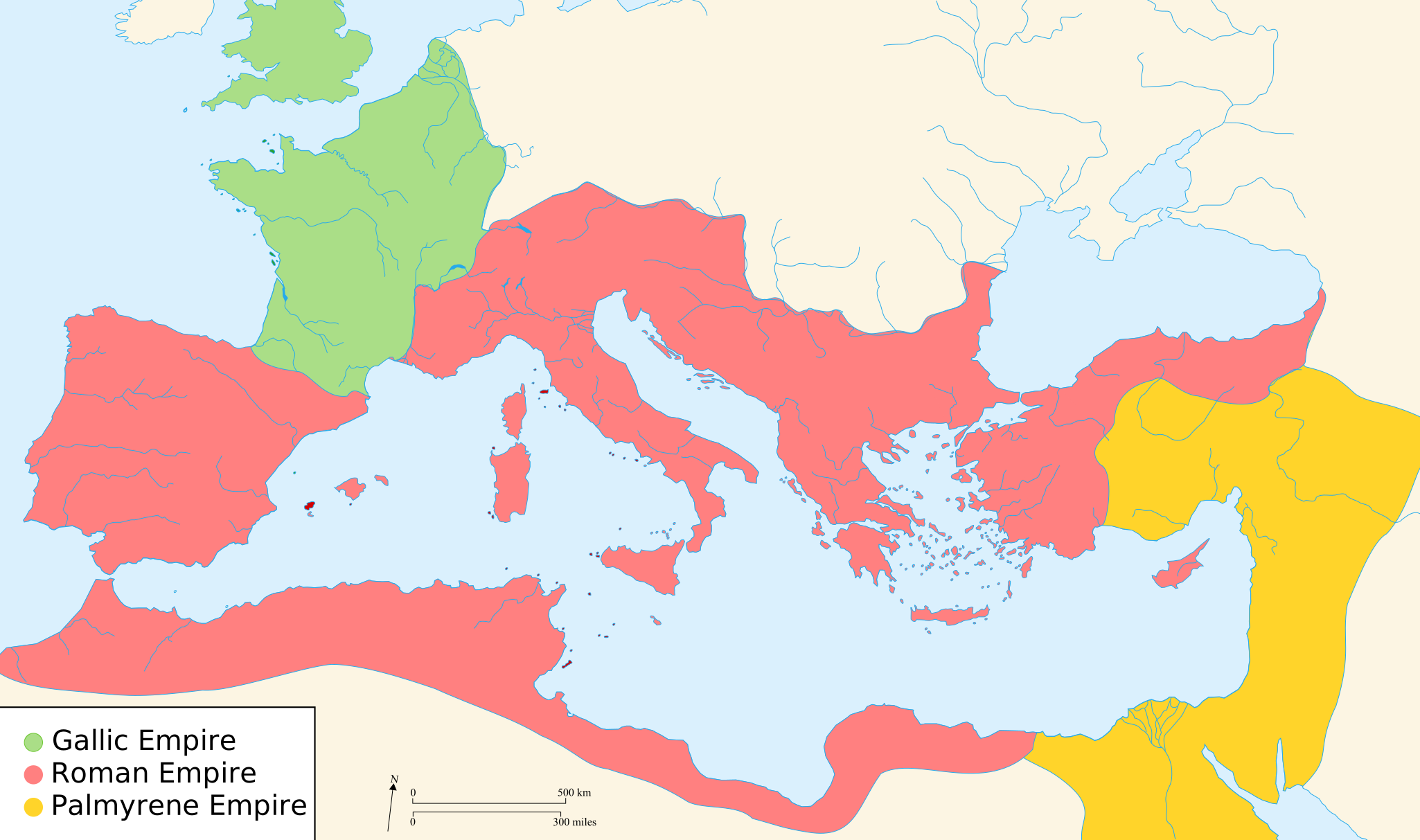
The 'working' mechanism of the Roman Empire during the Crisis was a brutal, short-sighted scramble for power and survival. Emperors were less administrators and more military strongmen, constantly needing to appease their legions with donatives and victories to avoid assassination. This led to a vicious cycle: successful generals seized the throne, rewarded their troops, and then faced challenges from other ambitious commanders. The economy suffered immensely as trade routes became perilous, and the constant need to fund armies led to the debasement of coinage, causing runaway inflation. Provincial governors and local elites often asserted greater autonomy, leading to the fragmentation of the empire into competing entities like the Gallic Empire and the Palmyrene Empire. It was a system designed for conquest, not for sustained internal stability, and it was breaking down spectacularly.
📊 Key Facts & Numbers
The numbers from the Crisis of the Third Century paint a grim picture of imperial instability. Between 235 and 284 CE, there were at least 26 recognized emperors, with many more usurpers claiming the purple, leading to an average reign of just under two years per emperor. Inflation reached staggering levels, with the denarius losing over 95% of its silver content by the end of the period. The empire faced invasions from numerous groups, including the Goths, Franks, Alamanni, and the Sasanian Persians, who even captured Emperor Valerian in 260 CE. The Plague of Cyprian, which ravaged the empire from approximately 249 to 262 CE, is estimated to have killed millions, potentially reducing the population by as much as 25% in some regions. By 270 CE, the empire was effectively divided into three major political entities: the Roman state under Aurelian, the Gallic Empire in the west, and the Palmyrene Empire in the east.
👥 Key People & Organizations
The Crisis of the Third Century was defined by a succession of powerful military figures and the organizations they commanded. Emperors like Maximinus Thrax, Decius, Trebonianus Gallus, Aemilianus, and Gallienus rose and fell with alarming speed, their reigns often marked by civil war and external threats. Figures like Postumus, who founded the Gallic Empire in 260 CE, and Zenobia, the formidable queen of Palmyra who carved out a vast eastern dominion, represent the fragmentation of Roman authority. The Praetorian Guard and the legions themselves became kingmakers, their loyalty bought with promises and spoils. Later, emperors like Claudius Gothicus and Aurelian emerged as 'restorers,' attempting to reassert central control, with Aurelian famously reuniting the empire by 274 CE. The Senate, once a powerful body, was largely sidelined, its influence eclipsed by military might.
🌍 Cultural Impact & Influence
The profound trauma of the Crisis of the Third Century left indelible marks on Roman culture and subsequent history. The constant warfare and economic hardship likely fostered a sense of fatalism and increased religiosity, with a growing interest in mystery cults and Christianity. The military's ascendance led to a more militarized society, reflected in art and propaganda that emphasized imperial strength and divine favor. The eventual reunification under emperors like Aurelian and the subsequent reforms of Diocletian and Constantine the Great created a more autocratic, centralized state, often referred to as the Dominate, a stark contrast to the earlier Principate. This period also saw the rise of the 'soldier emperor,' a figure whose legitimacy rested primarily on military success, a trend that would continue to shape Roman politics. The very concept of Roman invincibility was shattered, forcing a re-evaluation of the empire's place in the world.
⚡ Current State & Latest Developments
While the Crisis of the Third Century itself concluded in 284 CE with Diocletian's accession, its echoes continue to resonate in historical scholarship and archaeological findings. Ongoing excavations at sites like Sirmium and Aquincum provide tangible evidence of the period's fortifications and economic struggles. Historians continue to debate the precise causes and consequences, with new interpretations emerging regarding the role of climate change, plague dynamics, and the agency of various social groups. The discovery of new inscriptions and coins regularly refines our understanding of the numerous short-lived emperors and their policies. The legacy of this period is also visible in the enduring fascination with the 'barbarian' groups who challenged Rome, with ongoing research into their migrations and interactions with the Roman world.
🤔 Controversies & Debates
The Crisis of the Third Century is rife with debate, particularly concerning its causes and the nature of the 'restoration' that followed. Was it primarily an economic collapse, a military overreach, or a failure of political institutions? Some scholars emphasize the impact of the Plague of Cyprian and other epidemics, arguing that demographic collapse was a primary driver of instability. Others point to the Sasanian threat in the East as a critical factor that stretched Roman resources thin. A significant debate surrounds the effectiveness of the reforms implemented by Diocletian and Constantine the Great; while they stabilized the empire, did they merely mask deeper structural weaknesses or fundamentally transform Rome into a more resilient entity? The extent to which provincial elites and non-Roman populations contributed to or resisted the crisis also remains a subject of ongoing discussion.
🔮 Future Outlook & Predictions
The future trajectory of the Roman Empire was irrevocably altered by the Crisis of the Third Century. The reforms initiated by Diocletian, including the Tetrarchy and administrative restructuring, created a more compartmentalized and autocratic state, laying the groundwork for the Byzantine Empire in the East. The increased reliance on a professional, standing army and the fortification of cities became permanent features. The economic policies, while initially stabilizing, led to a more controlled and less free-market economy. The long-term impact on the Western Roman Empire, which eventually collapsed in 476 CE, is also a subject of speculation; some argue that the Crisis weakened it beyond recovery, while others contend that the reforms merely delayed the inevitable. The specter of fragmentation and the need for strong, centralized leadership became enduring themes in Roman political thought.
💡 Practical Applications
While the Crisis of the Third Century is a historical period, its study offers insights into the dynamics of state collapse and resilience. Understanding how the Roman Empire navigated simultaneous threats—military invasion, internal rebellion, and economic depression—provides case studies for modern political science and disaster management. The debasement of currency and hyperinflation during this era serve as stark warnings in economic history. Furthermore, the military strategies employed by emperors like Aurelian to reunite the empire and defend its borders are still analyzed in military academies. The period also highlights the critical role of leadership during times of extreme duress, showcasing both catastrophic failures and remarkable recoveries, influencing how we assess leadership in contemporary crises.
Key Facts
- Category
- history
- Type
- topic