
Contents
Overview
Deep belief networks (DBNs) were a significant step in the development of deep learning, demonstrating how to effectively train deep architectures before the widespread adoption of backpropagation for deep nets. These generative graphical models, pioneered by Geoffrey Hinton and his colleagues, are trained in a greedy, layer-by-layer fashion using unsupervised learning, often by stacking restricted Boltzmann machines (RBMs) or autoencoders. Each layer learns to represent features at a different level of abstraction, enabling the network to probabilistically reconstruct its inputs and subsequently be fine-tuned for supervised tasks like classification.
🎵 Origins & History
The conceptual lineage of deep belief networks traces back to the early 2000s, emerging from research into unsupervised learning and generative models. The DBN architecture was further popularized through Hinton's 2009 Scholarpedia article, 'Deep Belief Networks', solidifying its place as a key development in the resurgence of neural networks. Prior to this, restricted Boltzmann machines (RBMs), developed by Hinton and Terrence Sejnowski in 1985, served as crucial building blocks.
⚙️ How It Works
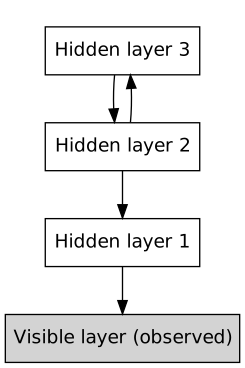
A deep belief network functions by stacking multiple layers of restricted Boltzmann machines (RBMs) or autoencoders. The training process is typically greedy and unsupervised, meaning each layer is trained independently before being used as input for the next. An RBM, for instance, consists of a visible layer and a hidden layer, trained to reconstruct its input. In a DBN, the hidden layer of one RBM becomes the visible layer of the next. This layer-wise pre-training allows the network to learn a hierarchy of features, starting with simple patterns in the initial layers and progressing to more complex, abstract representations in deeper layers. After this unsupervised pre-training, the entire network can be fine-tuned using backpropagation for specific supervised tasks, such as classification or regression.
📊 Key Facts & Numbers
Deep belief networks, while foundational, saw their peak research prominence in the late 2000s and early 2010s. While specific market share data for DBNs is scarce, their influence paved the way for deep learning models that now dominate AI, with the global AI market projected to reach over $1.8 trillion by 2030, a testament to the trajectory DBNs helped initiate.
👥 Key People & Organizations
The primary architect of deep belief networks is Geoffrey Hinton, often referred to as the 'godfather of deep learning'. His collaborations with Simon Osindero and Ye-Chu Yeo were instrumental in formalizing the DBN architecture and its training algorithm. Other key figures include Terrence Sejnowski, with whom Hinton co-developed the Restricted Boltzmann Machine (RBM) in 1985, a core component of DBNs. Organizations like the University of Toronto and Google AI have been significant hubs for research in deep learning, including work on DBNs and their successors. Yann LeCun and Jürgen Schmidhuber are also prominent figures in the broader deep learning revolution that DBNs helped to ignite.
🌍 Cultural Impact & Influence
Deep belief networks played a pivotal role in the 'AI winter' thaw, reigniting interest in deep neural networks. Their success in unsupervised feature learning demonstrated a viable path to training deep architectures, influencing subsequent research in areas like Convolutional Neural Networks (CNNs) and Recurrent Neural Networks (RNNs). The ability of DBNs to learn hierarchical representations resonated with fields like computer vision and natural language processing, even if later architectures proved more efficient for specific tasks. The conceptual framework of layer-wise learning and generative pre-training became a recurring theme in deep learning research, impacting how researchers approached complex model training. The DBN's influence can be seen in the foundational understanding of how deep networks learn abstract features.
⚡ Current State & Latest Developments
While deep belief networks were a groundbreaking development, their direct application has largely been superseded by more advanced deep learning architectures like Transformers and Generative Adversarial Networks (GANs). The layer-wise greedy training, while effective for its time, is less efficient and flexible than end-to-end training methods. However, the core principles of unsupervised pre-training and hierarchical feature learning remain highly relevant. Research continues into hybrid models and novel generative approaches that draw inspiration from DBNs. The ongoing advancements in self-supervised learning and representation learning can be seen as descendants of the DBN's foundational work in learning from unlabeled data.
🤔 Controversies & Debates
A primary debate surrounding deep belief networks centers on their practical efficacy compared to later architectures. While DBNs were crucial for demonstrating the feasibility of deep learning, their performance on many benchmark tasks has been surpassed by models like CNNs for image recognition and Transformers for sequence modeling. Critics argue that the greedy layer-wise training can lead to suboptimal solutions compared to end-to-end trained networks. Furthermore, the generative capabilities of DBNs, while significant, are often less powerful than those of modern GANs or Variational Autoencoders (VAEs). The debate also touches on the historical narrative of deep learning, with discussions about the relative contributions of different researchers and methodologies.
🔮 Future Outlook & Predictions
The future of deep belief networks themselves is likely limited as a distinct architecture, but their conceptual legacy is secure. The principles of unsupervised pre-training and hierarchical feature extraction continue to inform the development of new deep learning models. Future research may explore hybrid architectures that combine DBN-like pre-training with more powerful generative components or end-to-end training mechanisms. The ongoing push towards more data-efficient learning and the development of models that can learn complex representations without massive labeled datasets ensures that the ideas pioneered by DBNs will remain relevant. We might see renewed interest in their generative aspects for specific niche applications where their probabilistic modeling strengths are paramount.
💡 Practical Applications
Deep belief networks found practical applications primarily in areas requiring feature extraction from large, unlabeled datasets. Before the advent of more sophisticated models, DBNs were used for tasks such as image recognition, where they could learn hierarchical visual features. They were also applied to speech recognition, helping to extract meaningful patterns from raw audio signals. In bioinformatics, DBNs were explored for analyzing genetic sequences. While these applications have largely transitioned to newer architectures, the underlying concept of using generative models for pre-training remains influential in areas like representation learning and transfer learning, where models trained on one task are adapted for another.
Key Facts
- Category
- technology
- Type
- topic