
Contents
- 🎵 Origins & History
- ⚙️ How It Works
- 📊 Key Facts & Numbers
- 👥 Key People & Organizations
- 🌍 Cultural Impact & Influence
- ⚡ Current State & Latest Developments
- 🤔 Controversies & Debates
- 🔮 Future Outlook & Predictions
- 💡 Practical Applications
- 📚 Related Topics & Deeper Reading
- Frequently Asked Questions
- References
- Related Topics
Overview
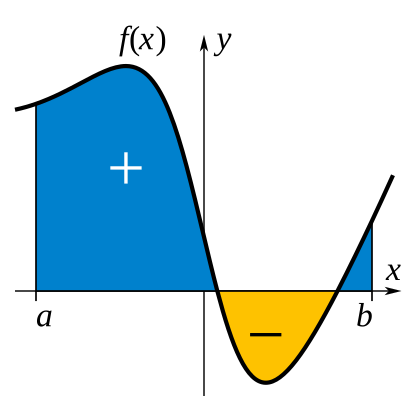
A definite integral is a cornerstone of calculus, quantifying the accumulated effect of a function over a specific interval. It represents the signed area between a function's graph and the x-axis, where areas above the axis are positive and those below are negative. This powerful concept, intrinsically linked to differentiation via the Fundamental Theorem of Calculus, allows mathematicians and scientists to calculate everything from the displacement of a moving object to the volume of complex three-dimensional shapes. Its origins trace back to ancient Greek mathematicians like Archimedes, who used methods of exhaustion to approximate areas, but it was formalized by Gottfried Wilhelm Leibniz and Isaac Newton in the 17th century. Today, definite integrals are indispensable across physics, engineering, economics, and statistics, underpinning models of continuous change and accumulation.
🎵 Origins & History
The conceptual seeds of the definite integral were sown in antiquity, with Archimedes employing the method of exhaustion around 250 BCE to calculate areas of circles and parabolic segments. However, the rigorous formalization of integration as a fundamental operation of calculus occurred in the late 17th century. Gottfried Wilhelm Leibniz introduced much of the notation still in use today, including the integral sign '∫' (derived from a long 'S' for 'sum') and the differential notation 'dx'. His work, alongside that of Isaac Newton, established the inverse relationship between differentiation and integration, a principle later codified as the Fundamental Theorem of Calculus. Early applications focused on geometric problems, such as finding areas and volumes, but the utility of definite integrals quickly expanded into physics and engineering.
⚙️ How It Works
At its heart, a definite integral, denoted as $\int_{a}^{b} f(x) dx$, represents the accumulation of a function $f(x)$ over a closed interval $[a, b]$. The process involves partitioning the interval into infinitesimally small subintervals, multiplying the function's value in each subinterval by the width of that subinterval (forming a Riemann sum), and summing these products. As the number of subintervals approaches infinity and their width approaches zero, this sum converges to a specific value. This value is the definite integral, interpreted geometrically as the signed area between the curve $y=f(x)$ and the x-axis from $x=a$ to $x=b$. Areas above the x-axis contribute positively, while areas below contribute negatively.
📊 Key Facts & Numbers
The definite integral is a quantitative powerhouse. For instance, the area under the curve $y=x^2$ from $x=0$ to $x=2$ is precisely $\int_{0}^{2} x^2 dx = \frac{8}{3}$, approximately 2.67 square units. In physics, the total distance traveled by an object with velocity $v(t)$ from time $t_1$ to $t_2$ is given by $\int_{t_1}^{t_2} |v(t)| dt$, which could be thousands of kilometers for a long-haul flight. The volume of a solid of revolution can be calculated using integrals, such as the volume of a sphere of radius $R$, which is $\frac{4}{3}\pi R^3$, derived from $\int_{0}^{R} \pi (R^2 - x^2) dx$. The average value of a function $f(x)$ over $[a, b]$ is $\frac{1}{b-a} \int_{a}^{b} f(x) dx$, a crucial metric in statistical analysis.
👥 Key People & Organizations
The development of the definite integral is inextricably linked to the giants of calculus. Gottfried Wilhelm Leibniz and Isaac Newton independently laid the groundwork in the 17th century. Later, mathematicians like Bernhard Riemann rigorously defined the integral through Riemann sums, establishing the conditions under which a function is integrable. Augustin-Louis Cauchy also made significant contributions to the formalization of calculus. While not directly inventing the definite integral, figures like Leonhard Euler extensively applied and expanded upon its use in various mathematical and physical problems. Today, the Society for Industrial and Applied Mathematics (SIAM) and organizations like the American Mathematical Society (AMS) continue to foster research and application of integral calculus.
🌍 Cultural Impact & Influence
The definite integral has permeated countless fields, fundamentally altering how we model and understand the world. Its ability to quantify accumulation is vital in engineering for calculating work done by variable forces, stress distribution in materials, and fluid dynamics. In economics, it's used to determine total cost, revenue, and consumer surplus over time. Statistics relies heavily on integrals for probability density functions, allowing calculation of probabilities over continuous ranges. The very concept of 'area under the curve' has become a ubiquitous metaphor in business and data analysis, signifying performance or impact over a period. The widespread adoption of Python and R with libraries like NumPy and SciPy has democratized access to numerical integration tools.
⚡ Current State & Latest Developments
In contemporary mathematics and science, the definite integral remains a bedrock concept, with ongoing research focusing on more efficient and robust numerical integration techniques for complex, high-dimensional problems. Advances in computational fluid dynamics and finite element analysis constantly push the boundaries of integral application. Machine learning algorithms, particularly in areas like Gaussian processes and reinforcement learning, often involve integral calculations for expected values and policy optimization. The development of specialized software packages like MATLAB and Mathematica continues to provide powerful tools for symbolic and numerical integration, making complex calculations accessible to a wider audience.
🤔 Controversies & Debates
While the mathematical framework of the definite integral is well-established, debates persist regarding its pedagogical approaches and the interpretation of its results in certain complex scenarios. Some educators argue for a stronger emphasis on intuitive geometric understanding before delving into formal Riemann sums, while others champion the rigor of the formal definition. In applied fields, the choice of integration method (e.g., Simpson's Rule vs. Trapezoidal Rule) can lead to minor discrepancies in results, sparking discussions about accuracy and computational efficiency. Furthermore, the application of integrals in areas like quantum mechanics, where they can represent probabilities or expectation values, sometimes leads to philosophical discussions about the nature of reality and measurement.
🔮 Future Outlook & Predictions
The future of the definite integral is likely to be shaped by increasing computational power and the growing complexity of scientific and engineering challenges. Expect to see more sophisticated algorithms for handling integrals in extremely high dimensions, crucial for fields like quantum chromodynamics and advanced climate modeling. The integration of symbolic and numerical methods, perhaps aided by AI-driven approaches, could lead to breakthroughs in solving previously intractable problems. As data becomes more pervasive, the ability to accurately integrate continuous functions derived from noisy data will become even more critical in fields ranging from finance to bioinformatics, ensuring the definite integral's enduring relevance.
💡 Practical Applications
Definite integrals are indispensable tools across numerous disciplines. In physics, they calculate work done by a variable force, the center of mass of an object, and the total impulse from a varying force. Engineers use them to determine the volume of irregularly shaped objects, the centroid of areas, and the moment of inertia for structural analysis. Economists employ integrals to model total cost, total revenue, and consumer/producer surplus over time. In probability and statistics, definite integrals are fundamental for calculating probabilities associated with continuous random variables, such as the probability of a value falling within a certain range, using probability density functions.
Key Facts
- Year
- 17th Century (formalization)
- Origin
- Europe
- Category
- science
- Type
- concept
Frequently Asked Questions
What is a definite integral in simple terms?
Imagine you have a graph of how fast something is moving over time. A definite integral is like adding up all the tiny distances it traveled during specific moments to find the total distance covered between two points in time. It's a way to measure the total accumulation of something that's constantly changing over a set period or range.
How does a definite integral relate to area?
Geometrically, a definite integral represents the signed area between a function's graph and the x-axis over a given interval. If the function is above the x-axis, the area is positive; if it's below, the area is negative. This connection is fundamental, allowing us to calculate areas of complex shapes by summing up infinitely many infinitesimally thin rectangles under the curve.
What is the significance of the Fundamental Theorem of Calculus?
The Fundamental Theorem of Calculus is monumental because it establishes a direct link between differentiation and integration, showing they are inverse operations. This means you don't always have to use the cumbersome method of summing infinite rectangles (Riemann sums) to find the definite integral. Instead, you can often find an antiderivative and evaluate it at the interval's endpoints, dramatically simplifying calculations across all of calculus.
Who invented the definite integral?
The concept of finding areas under curves existed long before modern calculus, with Archimedes using methods of exhaustion. However, the formal definition and notation of the definite integral as we know it today were developed by Gottfried Wilhelm Leibniz and Isaac Newton in the late 17th century as part of their invention of calculus. Bernhard Riemann later provided a rigorous mathematical definition in the 19th century.
Why are there negative areas in definite integrals?
The 'signed area' concept is crucial. When a function's graph dips below the x-axis, the integral calculates the area of that region as negative. This is important because it correctly accounts for cancellations in accumulation. For example, if velocity is negative (moving backward), the integral of velocity gives displacement, not total distance, so negative contributions are essential for tracking net change.
How do you calculate a definite integral if you can't find an antiderivative?
When an antiderivative is difficult or impossible to find analytically, mathematicians and scientists use numerical integration methods. Techniques like the Trapezoidal Rule, Simpson's Rule, or more advanced methods implemented in software like SciPy approximate the integral by dividing the area into a finite number of shapes (trapezoids, parabolas) and summing their areas. This provides a very accurate estimate for practical purposes.
What are some real-world examples of definite integrals?
Definite integrals are used everywhere: calculating the total work done by a variable force in physics, determining the total cost or revenue over a period in economics, finding the probability of a continuous random variable falling within a range in statistics, and calculating the volume of irregularly shaped objects in engineering. They are the mathematical engine behind understanding cumulative effects.