
Contents
Overview
The concept of fermions emerged from the groundbreaking work of Wolfgang Pauli in 1925, who formulated the Pauli exclusion principle to explain the structure of electron shells in atoms, a crucial insight for understanding chemical bonding and the periodic table. This principle, stating that no two identical fermions can occupy the same quantum state, was a radical departure from classical physics. Enrico Fermi then developed the statistical framework, Fermi-Dirac statistics, to describe the behavior of such particles, solidifying their classification. The distinction between fermions and bosons was further cemented by the spin-statistics theorem, a fundamental result in relativistic quantum field theory developed by physicists like Julian Schwinger and Arthur Wightman, which mathematically links a particle's spin to its statistical behavior. Early observations of electron behavior in metals by Hendrik Lorentz and Arnold Sommerfeld hinted at these unique properties, paving the way for Pauli's definitive formulation.
⚙️ How It Works
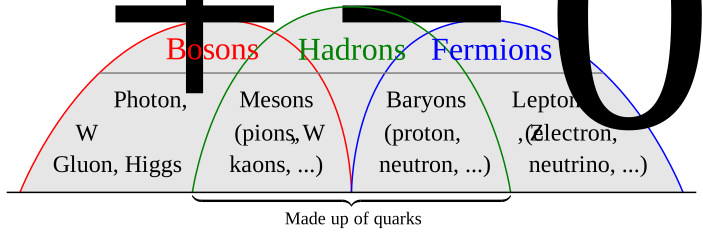
Fermions operate under a strict quantum mechanical rule: the Pauli exclusion principle. This means that if you have two identical fermions, like two electrons, they cannot simultaneously possess the exact same set of quantum numbers (energy, momentum, spin orientation, etc.). Imagine a set of hotel rooms; each fermion insists on having its own private room. This principle is the bedrock of atomic structure, dictating how electrons fill orbitals around an atomic nucleus, thereby defining the chemical properties of elements. Elementary fermions, such as electrons and quarks, are fundamental and indivisible. Composite fermions, like protons and neutrons (which are baryons), are made of an odd number of elementary fermions. The spin-statistics theorem in quantum field theory mathematically proves that particles with half-integer spin (e.g., 1/2, 3/2) must be fermions and obey Fermi-Dirac statistics, while integer-spin particles are bosons.
📊 Key Facts & Numbers
There are precisely 12 known types of elementary fermions in the Standard Model: six quarks (up, down, charm, strange, top, bottom) and six leptons (electron, muon, tau, and their corresponding neutrinos). Each of these has an antiparticle with opposite charge and quantum numbers. Fermions constitute all ordinary matter; for instance, protons and neutrons, themselves composite fermions, make up atomic nuclei, while electrons orbit these nuclei. The mass of the universe is overwhelmingly dominated by fermions, with estimates suggesting that baryonic matter (made of quarks and leptons) accounts for about 4.9% of the total mass-energy density of the universe, according to Planck mission data. The electron, a fundamental fermion, has a mass of approximately 9.109 x 10^-31 kilograms.
👥 Key People & Organizations
The conceptualization of fermions is inextricably linked to Wolfgang Pauli, who introduced the exclusion principle in 1925, earning him the Nobel Prize in Physics in 1945. Enrico Fermi, an Italian-American physicist, further developed the statistical mechanics for these particles, leading to Fermi-Dirac statistics, and also won a Nobel Prize in 1938 for his work on beta decay. Paul Dirac, a British theoretical physicist, unified quantum mechanics and special relativity, predicting antimatter and contributing significantly to the understanding of fermion behavior through the Dirac equation. Key experimental efforts at facilities like CERN and Fermilab continue to probe the properties of fundamental fermions, with collaborations involving thousands of scientists worldwide, such as the ATLAS and CMS experiments at the Large Hadron Collider.
🌍 Cultural Impact & Influence
Fermions are the reason matter has substance and occupies space. The Pauli exclusion principle prevents all electrons in an atom from collapsing into the lowest energy state, forcing them into distinct orbitals, which directly leads to the diversity of chemical elements and the formation of molecules. This principle is fundamental to the stability of matter; without it, atoms would collapse, and stars would not be able to undergo nuclear fusion in the way they do. The distinctness of fermions is also what allows for complex biological systems to arise. In astrophysics, the degeneracy pressure exerted by fermions, particularly neutrons in neutron stars, counteracts gravitational collapse, allowing these incredibly dense objects to exist. The very concept of 'stuff' is a fermionic phenomenon.
⚡ Current State & Latest Developments
Current research into fermions focuses on precisely measuring their properties and searching for deviations from the Standard Model. Experiments at CERN are constantly refining measurements of the mass and decay modes of fundamental fermions like the top quark and tau lepton. Physicists are also investigating the possibility of neutrino oscillations and the absolute mass of neutrinos, which could reveal physics beyond the Standard Model. The search for supersymmetry predicts that each known fermion might have a heavier bosonic superpartner, a hypothetical particle that experiments at the Large Hadron Collider are actively seeking. Understanding the precise nature of dark matter, which may or may not be fermionic, remains a paramount goal for particle physics.
🤔 Controversies & Debates
A significant debate revolves around the nature of dark matter and dark energy. While the Standard Model's fermions account for all visible matter, they cannot explain the gravitational effects attributed to dark matter. Some theories propose that dark matter could be composed of a new type of weakly interacting massive particle (WIMP), which would be a fermion. Conversely, other theories suggest dark matter might be bosonic. Another area of contention is the precise mass of neutrinos; while known to be non-zero, their exact values and whether they are Majorana fermions (their own antiparticles) are still subjects of intense experimental and theoretical investigation. The hierarchy problem—why gravity is so much weaker than other forces—also touches upon the fundamental nature of fermions and bosons.
🔮 Future Outlook & Predictions
The future of fermion research is deeply intertwined with the quest for a unified theory of physics. Future particle colliders, potentially larger and more powerful than the Large Hadron Collider, will aim to discover new fundamental fermions or test theories like supersymmetry that predict them. Investigating the properties of neutrinos with even greater precision could unlock secrets about the early universe and the matter-antimatter asymmetry. Furthermore, understanding the collective behavior of fermions in exotic states of matter, such as superconductors and superfluids, may lead to novel technological applications. The ongoing exploration of neutron stars and black holes by observatories like Event Horizon Telescope will provide crucial astrophysical data on fermionic matter under extreme conditions.
💡 Practical Applications
Fermions are the reason we have solid objects. The Pauli exclusion principle prevents electrons from occupying the same space, giving matter its volume and preventing us from falling through our chairs. This principle is also fundamental to semiconductor technology, the basis of all modern electronics, where the behavior of electrons (fermions) in specific materials is precisely controlled. In astrophysics, the degeneracy pressure of neutrons in neutron stars, a direct consequence of the exclusion principle, prevents these stellar remnants from collapsing further. Understanding fermion behavior is also critical for developing superconductors and superfluids, materials that exhibit quantum phenomena at macroscopic scales, with potential applications in energy transmission and high-speed computing.
Key Facts
- Category
- science
- Type
- topic