
Contents
Overview
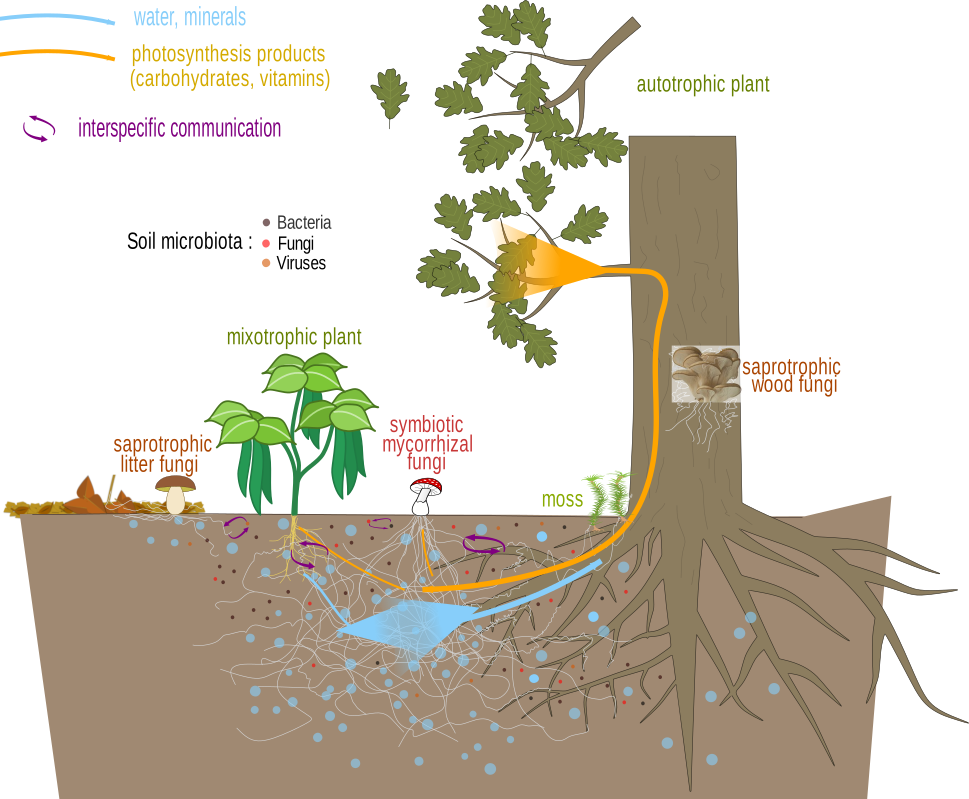
Fungal networks, primarily referring to mycorrhizal networks, are vast underground systems formed by the thread-like hyphae of fungi that connect the roots of plants. These intricate webs, often spanning entire ecosystems like forests, facilitate the exchange of nutrients, water, and chemical signals between plants, blurring the lines of individual plant autonomy and revealing a complex, cooperative subterranean world. First scientifically elucidated by forest ecologist Suzanne Simard in the late 1990s, these networks challenge traditional views of plant competition, demonstrating a sophisticated form of inter-plant communication and resource sharing. The scale of these networks is staggering, with a single cubic inch of soil potentially containing miles of fungal hyphae, supporting a vibrant, hidden economy of biological exchange that is crucial for ecosystem health and resilience. Understanding fungal networks is vital for comprehending forest dynamics, plant evolution, and the very fabric of terrestrial life.
🎵 Origins & History
The concept of underground connections between plants has ancient roots, with early observations hinting at symbiotic relationships between fungi and roots dating back to the late 19th century. However, it was Suzanne Simard, a professor of forest ecology at the University of British Columbia, who in 1997 provided the first robust scientific evidence for what she termed 'common mycorrhizal networks' (CMNs). Growing up in the forests of British Columbia, where her family worked in forestry, Simard was inspired to investigate the seemingly interconnected nature of trees. Her groundbreaking experiments, often involving radioactive isotopes to trace nutrient flow, revealed that trees, particularly older 'mother trees,' could transfer carbon and other resources to younger seedlings via these fungal conduits, challenging the prevailing notion of plants as solitary competitors. This paradigm shift began to unravel the complex social lives of plants.
⚙️ How It Works
Fungal networks function as a biological internet, primarily through the symbiotic association between fungi and plant roots, known as mycorrhizae. The fungi, specifically their microscopic, thread-like hyphae, extend far beyond the reach of plant roots, vastly increasing the surface area for absorbing water and essential nutrients like phosphorus and nitrogen from the soil. In return, plants provide the fungi with carbohydrates produced during photosynthesis. These hyphae then fuse to form a continuous network, linking the root systems of multiple plants, even those of different species. Through this network, plants can share resources, send chemical distress signals (e.g., in response to insect attacks), and even influence the growth and defense mechanisms of their neighbors, creating a complex, cooperative ecosystem.
📊 Key Facts & Numbers
The sheer scale of fungal networks is astonishing: a single cubic inch of forest soil can contain up to 8 miles of fungal hyphae. Globally, it's estimated that over 90% of terrestrial plant species form mycorrhizal associations. These networks can connect hundreds or even thousands of trees across vast areas, with some individual fungal networks potentially spanning hundreds of acres. For instance, a single Armillaria ostoyae fungus in Oregon, nicknamed 'the Humongous Fungus,' covers over 2,385 acres and is estimated to be thousands of years old, demonstrating the immense scale and longevity of some fungal structures. The biomass of mycorrhizal fungi in forest soils can represent a significant portion of the total soil biomass, often exceeding 30%.
👥 Key People & Organizations
The foundational figure in understanding fungal networks is Suzanne Simard, whose pioneering work at the University of British Columbia in the late 1990s and early 2000s brought CMNs to the forefront of ecological research. Her research team has consistently pushed the boundaries of our understanding of plant communication. Other key researchers include David Leake, whose work has explored the diversity and function of fungal networks in various ecosystems, and Merlin Sheldrake, a biologist whose popular science book, Entangled Life, has significantly raised public awareness about the crucial role of fungi, including their networked structures. Organizations like the Forest Stewardship Council and various university departments of ecology and mycology are actively involved in research and conservation efforts related to these vital systems.
🌍 Cultural Impact & Influence
Fungal networks have profoundly influenced our perception of plants and ecosystems, shifting the narrative from individualistic competition to a more cooperative and interconnected view of nature. This has resonated in popular science, with books like Merlin Sheldrake's Entangled Life (2020) captivating a wide audience and highlighting the 'intelligence' and social behavior of fungi. The concept has also seeped into environmental activism and conservation, emphasizing the importance of preserving soil health and biodiversity for ecosystem resilience. In art and literature, the idea of hidden, interconnected worlds beneath the surface offers rich metaphorical ground, influencing themes of community, communication, and the unseen forces that shape our environment. The visual metaphor of the 'wood wide web' has become a powerful symbol for ecological interconnectedness.
⚡ Current State & Latest Developments
Current research is rapidly expanding our understanding of fungal networks, moving beyond nutrient transfer to explore their role in plant defense signaling, community assembly, and even their potential impact on climate change mitigation through carbon sequestration. Scientists are increasingly using advanced imaging techniques, DNA sequencing, and stable isotope tracing to map the complexity and dynamics of these networks in real-time. For instance, studies continue to investigate how different plant species interact within these networks and how these interactions are affected by environmental stressors like drought and pollution. The focus is also shifting towards understanding how human activities, such as logging and agriculture, disrupt these vital connections and what strategies can be employed to protect or even restore them.
🤔 Controversies & Debates
The interpretation of fungal networks is not without its debates. While the existence and function of CMNs are widely accepted, the extent to which plants 'intentionally' communicate or 'help' each other is a point of contention. Some researchers argue that the observed resource transfer is a byproduct of fungal efficiency rather than deliberate plant altruism, cautioning against anthropomorphizing plant behavior. The precise mechanisms and the degree of specificity in signaling are still areas of active investigation. Furthermore, the potential for parasitic or exploitative relationships within these networks, where some plants or fungi might benefit at the expense of others, adds another layer of complexity to the 'cooperative' narrative. The role of these networks in invasive species success is also a debated topic.
🔮 Future Outlook & Predictions
The future of fungal network research promises to unlock deeper insights into ecosystem functioning and potentially revolutionize fields like agriculture and forestry. We can anticipate more sophisticated mapping of global fungal networks, revealing their full extent and diversity. Predictive models will likely emerge to forecast how these networks respond to climate change and land-use alterations, guiding conservation efforts. In agriculture, harnessing mycorrhizal fungi could lead to reduced fertilizer use and increased crop resilience, a concept explored in precision agriculture initiatives. The potential for bio-engineering fungi to enhance specific functions within these networks, such as carbon sequestration or phytoremediation, is also a significant area of future exploration, with early-stage research already underway.
💡 Practical Applications
Fungal networks have significant practical applications, particularly in ecological restoration and sustainable agriculture. In forestry, understanding CMNs can inform reforestation strategies, ensuring the establishment of healthy, interconnected stands of trees. In agriculture, inoculating crops with beneficial mycorrhizal fungi can enhance nutrient uptake, improve water retention, and boost plant resistance to diseases and pests, thereby reducing the need for chemical fertilizers and pesticides. This practice, known as 'mycorrhizal inoculation,' is gaining traction in organic farming and regenerative agriculture. Furthermore, the ability of fungal networks to facilitate the transfer of compounds could be explored for phytoremediation, using plants and fungi to clean up contaminated soils.
Key Facts
- Category
- nature
- Type
- topic