
Contents
Overview
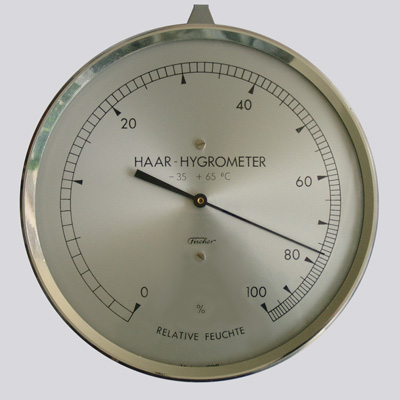
The lineage of the hygrometer stretches back to the late 15th century. Significant advancements occurred in the 17th century, notably by Francesco Folli, who developed a more practical instrument. By the 18th century, scientists like Johann Heinrich Lambert were refining hair hygrometers, utilizing the property of human hair to lengthen and shorten with varying humidity. The 19th century saw the development of more sophisticated mechanical hygrometers, such as the wet-bulb and dry-bulb psychrometer, which became standard tools in meteorological stations worldwide, including those operated by the U.S. Weather Bureau (now NOAA).
⚙️ How It Works
Modern hygrometers employ diverse principles to measure humidity. Capacitive hygrometers, a prevalent electronic type, utilize a dielectric material sandwiched between two electrodes; as moisture is absorbed, the dielectric constant changes, altering the capacitance, which is then measured. Resistive hygrometers, another common electronic variant, measure the change in electrical resistance of a material (often a polymer or salt) as it absorbs water vapor. More advanced instruments, like chilled-mirror hygrometers, determine the dew point by cooling a surface until condensation forms, then measuring the temperature at which this occurs. Some mechanical hygrometers still rely on organic materials like hair or synthetic polymers that physically expand or contract with humidity changes, moving a needle on a calibrated dial.
📊 Key Facts & Numbers
The global market for humidity sensors, a key component of hygrometers, was valued at approximately $2.7 billion in 2022 and is projected to reach $4.5 billion by 2028, growing at a compound annual growth rate (CAGR) of 8.9%. The most common type of sensor is capacitive, accounting for over 50% of the market share. Industrial applications represent the largest segment, consuming over 35% of all humidity sensors. In meteorology, accurate humidity readings are crucial; a 1% change in relative humidity can significantly impact weather forecasting models used by agencies like the UK Met Office. The precision of hygrometers can range from ±1% to ±5% relative humidity (RH) for consumer-grade devices, while scientific-grade instruments can achieve ±0.1% RH.
👥 Key People & Organizations
Beyond Leonardo da Vinci and Francesco Folli, key figures include Johann Heinrich Lambert, whose work on hair hygrometers was foundational. In the industrial sector, companies like Vaisala Oyj, founded in 1936, have become global leaders in environmental measurement technology, producing highly accurate hygrometers for professional use. Omega Engineering and Honeywell International Inc. are also significant players, developing a wide range of humidity sensors and instruments for various markets. The development of solid-state electronic sensors owes much to advancements in materials science and semiconductor manufacturing, driven by research institutions and corporations alike.
🌍 Cultural Impact & Influence
Hygrometers have subtly but profoundly shaped human environments and activities. In agriculture, they enable precise control of greenhouse conditions, optimizing crop growth for produce ranging from delicate orchids to staple grains, impacting global food security. In museums and archives, they are vital for preserving priceless artifacts, preventing mold growth and material degradation on items like ancient manuscripts and historical textiles. The comfort and health implications are also significant; maintaining optimal indoor humidity levels, monitored by home hygrometers, can alleviate respiratory issues and prevent the spread of airborne viruses like influenza, as studied by institutions like the Harvard T.H. Chan School of Public Health.
⚡ Current State & Latest Developments
The current landscape of hygrometers is dominated by miniaturized, low-cost electronic sensors integrated into smart home devices, HVAC systems, and portable weather stations. The advent of the Internet of Things (IoT) has spurred the development of networked hygrometers that transmit real-time data to cloud platforms, enabling remote monitoring and automated adjustments. Companies like Google Nest and Ecobee embed humidity sensors in their smart thermostats, allowing users to manage indoor climate more effectively. Furthermore, advancements in MEMS (Micro-Electro-Mechanical Systems) technology are leading to even smaller, more energy-efficient, and cost-effective humidity sensing solutions, with new product launches occurring quarterly from manufacturers like Sensirion AG.
🤔 Controversies & Debates
A persistent debate revolves around the accuracy and calibration drift of low-cost electronic hygrometers. While convenient, many consumer-grade devices can deviate significantly from true humidity levels over time, requiring recalibration or replacement. This has led to skepticism among professionals who rely on highly accurate readings for critical applications, contrasting them with the more stable, albeit expensive, mechanical or chilled-mirror hygrometers. Another point of contention is the definition and measurement of relative humidity itself, which is inherently dependent on temperature, leading to potential confusion and misinterpretation in everyday use, a topic often clarified by meteorological organizations like the World Meteorological Organization.
🔮 Future Outlook & Predictions
The future of hygrometers points towards increased integration, intelligence, and precision. We can expect widespread adoption of 'smart' hygrometers capable of predictive analytics, forecasting potential mold growth or material stress based on historical humidity patterns. Research is ongoing into novel sensing materials that offer greater sensitivity, faster response times, and enhanced durability in extreme conditions. The development of non-contact hygrometry, potentially using infrared spectroscopy or terahertz waves, could revolutionize fields requiring sterile or inaccessible measurement points, such as in pharmaceutical manufacturing or deep-space exploration. The goal is to move beyond simple measurement to proactive environmental management.
💡 Practical Applications
Hygrometers find indispensable applications across numerous sectors. In meteorology, they are fundamental for weather forecasting and climate monitoring, used by national weather services like the Japan Meteorological Agency. In industrial settings, they control humidity in cleanrooms for semiconductor manufacturing, prevent condensation in data centers, and ensure optimal conditions for food storage and pharmaceutical production. For consumers, home hygrometers help manage indoor air quality, prevent mold in bathrooms and basements, and maintain comfort. They are also critical in specialized fields like historical preservation, printing, and even in the calibration of other scientific instruments.
Key Facts
- Category
- technology
- Type
- product