
Contents
Overview
The genesis of integrated circuit design can be traced back to the late 1950s, a direct offshoot of the invention of the transistor and the subsequent realization that multiple components could be fabricated on a single piece of semiconductor material. Jack Kilby at Texas Instruments is widely credited with inventing the first rudimentary IC in 1958, a germanium-based device that integrated two transistors. Robert Noyce at Fairchild Semiconductor independently developed a more practical silicon-based IC in 1959, utilizing silicon dioxide for insulation, a foundational technique that paved the way for mass production. Early designs were rudimentary, often hand-drawn, and limited in complexity, but they laid the groundwork for the exponential growth in transistor density predicted by Gordon Moore in his famous 1965 observation, now known as Moore's Law. The development of Computer-Aided Design (CAD) tools occurred in the 1970s and 1980s, such as those from Synopsys and Cadence Design Systems, was critical in managing the escalating complexity and enabling the creation of more sophisticated chips.
⚙️ How It Works
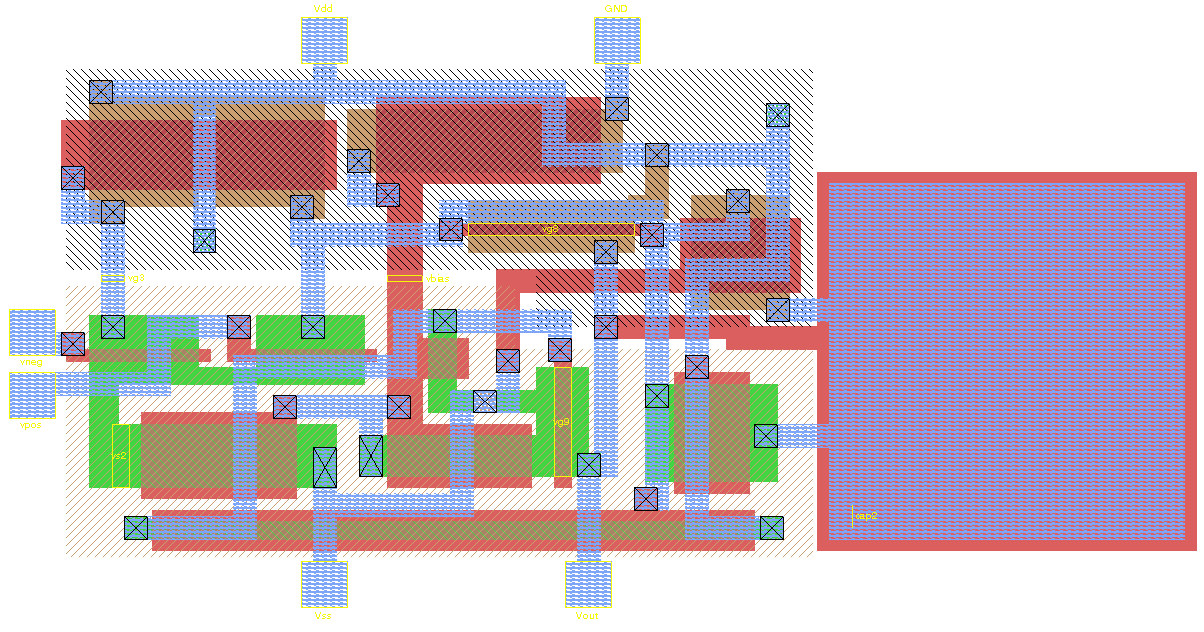
At its core, integrated circuit design involves translating a functional specification into a physical layout that can be manufactured on a silicon wafer. This process typically begins with logic synthesis, where high-level hardware description languages (HDLs) like Verilog or VHDL are converted into a netlist of standard logic gates. This netlist then undergoes placement and routing, where the gates are physically positioned on the chip die and interconnected by metal wires, a critical step managed by sophisticated EDA (Electronic Design Automation) tools. Physical verification ensures the design adheres to manufacturing design rules (DRC) and checks for electrical rule violations (ERC). For analog circuits, the process is more iterative and often involves detailed device-level modeling and simulation, focusing on parameters like gain, bandwidth, and noise, rather than just logical correctness. The final output is a set of manufacturing instructions, known as a GDSII file, sent to foundries like TSMC or Samsung Electronics.
📊 Key Facts & Numbers
The scale of modern IC design is almost incomprehensible. The global semiconductor market, driven by IC design, was valued at approximately $600 billion in 2023, with projections indicating continued growth. Developing these complex chips can cost upwards of $100 million for design and verification, and billions more for manufacturing setup. A single FPGA from Xilinx (now part of AMD) can contain millions of logic cells, offering immense flexibility. The Internet of Things (IoT) alone is projected to require billions of low-power ICs annually, highlighting the sheer volume of chip production. The average clock speed for high-performance CPUs has plateaued around 5 GHz, but performance gains are now achieved through architectural improvements and increased core counts, enabled by advanced IC design.
👥 Key People & Organizations
Key figures in IC design include Jack Kilby and Robert Noyce, the co-inventors of the integrated circuit, whose foundational work at Texas Instruments and Fairchild Semiconductor respectively, revolutionized electronics. Gordon Moore, co-founder of Intel, articulated Moore's Law, a prediction that has guided the industry's relentless progress for decades. Geoffrey E. Dutton and David A. Hodges were instrumental in early CAD tool development. Major organizations driving IC innovation include semiconductor giants like Intel, AMD, Nvidia, and Qualcomm, alongside foundries such as TSMC and Samsung Electronics. EDA companies like Synopsys, Cadence Design Systems, and Mentor Graphics (now part of Siemens Digital Industries Software) provide the essential software tools that enable modern chip design. Research institutions like Stanford University and MIT continue to push the boundaries of semiconductor technology.
🌍 Cultural Impact & Influence
The impact of integrated circuit design on global culture and technology is immeasurable. It is the bedrock of the digital revolution, enabling everything from personal computers and smartphones to the internet and artificial intelligence. The miniaturization achieved through IC design has made portable electronics ubiquitous, fundamentally altering communication, entertainment, and work. The development of specialized ICs, such as GPUs by Nvidia, has fueled advancements in fields like scientific simulation, machine learning, and high-fidelity gaming. The ability to integrate complex functionalities onto a single chip has also democratized access to powerful computing, fostering innovation across countless industries and enabling the smart home and wearable technology markets. Without IC design, the modern world as we know it simply wouldn't exist.
⚡ Current State & Latest Developments
The current landscape of IC design is defined by an intense race towards smaller process nodes. Artificial intelligence and machine learning are profoundly influencing design methodologies, with AI being used for tasks like logic synthesis, placement and routing, and verification, promising to accelerate design cycles. Chiplet technology is gaining significant traction, allowing complex systems to be built from smaller, interconnected dies, offering greater flexibility and yield. The geopolitical significance of semiconductor manufacturing has also surged, leading to increased government investment in domestic chip production and design capabilities, exemplified by initiatives like the CHIPS and Science Act in the United States and similar programs in Europe and Asia. The demand for specialized ASICs for AI acceleration, automotive applications, and high-performance computing continues to drive innovation.
🤔 Controversies & Debates
One of the most persistent debates in IC design revolves around Moore's Law. While transistor density continues to increase, the rate of doubling has slowed, and the cost of developing new process nodes has skyrocketed, leading some to question its continued relevance or predict its eventual end. Another significant controversy concerns the environmental impact of semiconductor manufacturing, which is highly resource-intensive and generates considerable waste and chemical byproducts. Ethical considerations also arise regarding the concentration of manufacturing power in a few geographic regions, particularly Taiwan, creating supply chain vulnerabilities. Furthermore, the increasing complexity of verification poses a major challenge; ensuring the functional correctness of chips with billions of transistors is a monumental task, and bugs can lead to costly recalls or redesigns, as seen in past CPU flaws. The debate over open-source hardware design versus proprietary IP also continues to shape the industry.
🔮 Future Outlook & Predictions
The future of IC design is poised for transformative changes. Expect continued advancements in [[art
Key Facts
- Category
- technology
- Type
- topic