
Contents
- 🎵 Origins & History
- ⚙️ How It Works
- 📊 Key Facts & Numbers
- 👥 Key People & Organizations
- 🌍 Cultural Impact & Influence
- ⚡ Current State & Latest Developments
- 🤔 Controversies & Debates
- 🔮 Future Outlook & Predictions
- 💡 Practical Applications
- 📚 Related Topics & Deeper Reading
- Frequently Asked Questions
- References
- Related Topics
Overview
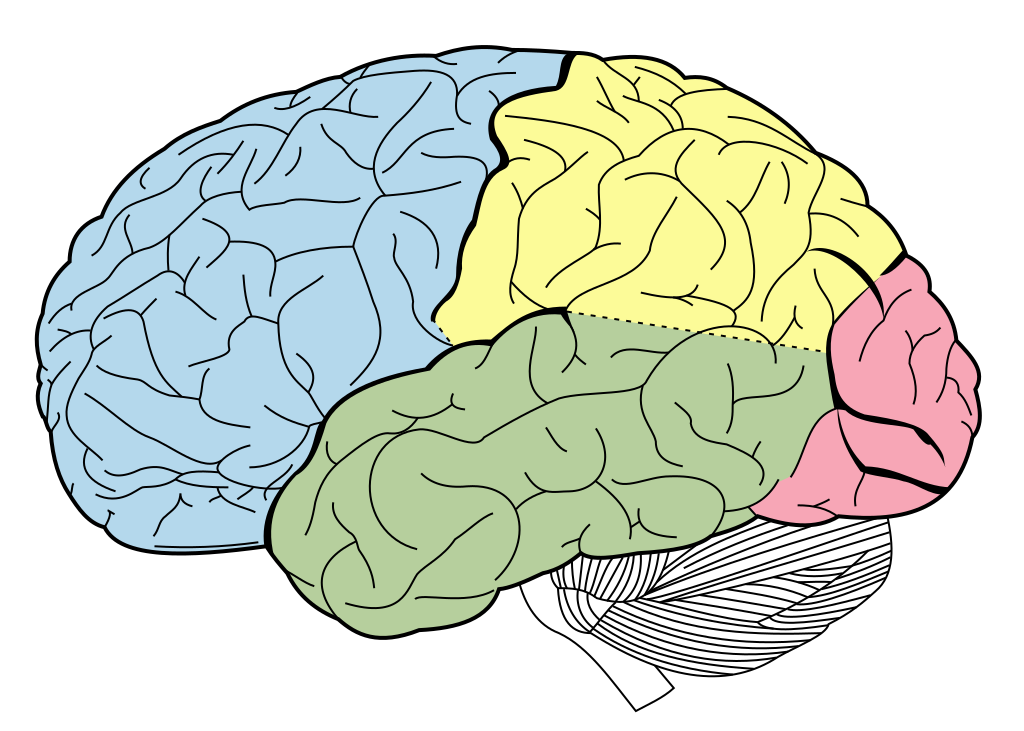
The roots of neuropsychology can be traced back to the 19th century, with early pioneers like Paul Broca and Carl Wernicke identifying specific brain regions associated with language functions through lesion studies. Broca's discovery in the 1860s of an area in the frontal lobe (now known as Broca's area) linked to speech production, and Wernicke's later identification of an area in the temporal lobe (Wernicke's area) crucial for language comprehension, laid foundational groundwork. The formalization of neuropsychology as a distinct discipline gained momentum in the mid-20th century, particularly following World War II, as researchers and clinicians grappled with the cognitive and behavioral sequelae of brain injuries sustained by soldiers. Figures like Donald O. Hebb contributed theoretical frameworks, while the development of standardized assessment tools in the 1950s and 1960s, such as the Halstead-Reitan Neuropsychological Test Battery, solidified its clinical identity. The establishment of professional organizations like the National Academy of Neuropsychology in 1980 further cemented its status.
⚙️ How It Works
Neuropsychology operates by examining the relationship between brain structures and psychological functions. At its core, it involves assessing cognitive abilities such as memory, attention, executive functions (planning, problem-solving, inhibition), language, visuospatial skills, and emotional regulation. This is achieved through a battery of standardized tests, interviews with patients and their families, and often, the review of neuroimaging data like MRI or CT scans. Neuropsychologists infer brain-behavior relationships by observing how deficits in these cognitive domains correlate with specific patterns of brain damage or dysfunction, whether caused by injury, disease, or developmental factors. The field also utilizes experimental paradigms to study brain mechanisms in healthy individuals, often employing techniques like EEG or fMRI to observe brain activity during cognitive tasks. This dual approach allows for both clinical diagnosis and fundamental scientific understanding.
📊 Key Facts & Numbers
The field of neuropsychology quantifies brain-behavior relationships with striking precision. For instance, estimates suggest that approximately 1.7 million traumatic brain injuries (TBIs) occur annually in the United States alone, many leading to significant cognitive deficits. Studies on Alzheimer's disease indicate that memory impairment can be detectable up to six years before clinical diagnosis, highlighting the role of early neuropsychological assessment. In clinical practice, neuropsychological evaluations can involve administering up to fifteen different tests per patient, consuming an average of eight hours of direct testing time. The global market for neurological disorder treatments, which often involve neuropsychological interventions, was valued at over 100 billion USD in 2023 and is projected to grow substantially. Furthermore, research indicates that approximately 30-40% of individuals with epilepsy experience some form of cognitive impairment, underscoring the prevalence of neurological conditions requiring neuropsychological attention.
👥 Key People & Organizations
Several key figures and organizations have shaped neuropsychology. Alexander Luria, a Soviet neuropsychologist, developed a systematic approach to studying the effects of brain lesions on behavior, influencing diagnostic methods worldwide. Brenda Milner, based at the Montreal Neurological Institute, conducted seminal work on Patient H.M., revolutionizing our understanding of memory. In the United States, Ralph Reitan was instrumental in developing and validating the Halstead-Reitan Neuropsychological Test Battery, a cornerstone of clinical assessment. Professional bodies like the American Academy of Clinical Neuropsychology (AACN) and the International Neuropsychological Society (INS) play vital roles in setting standards, promoting research, and advocating for the profession. Major research institutions, including Johns Hopkins University and Stanford University, house leading neuropsychology departments and research centers.
🌍 Cultural Impact & Influence
Neuropsychology's influence extends far beyond clinical settings, permeating popular culture and scientific discourse. The dramatic portrayal of cognitive changes following brain injury in films like "The Theory of Everything" (depicting Stephen Hawking's experience with ALS) or "50 First Dates" (illustrating anterograde amnesia) brings neuropsychological concepts to a broad audience, albeit often with dramatic license. In education, understanding learning disabilities and attention-deficit/hyperactivity disorder (ADHD) relies heavily on neuropsychological principles. The field has also informed the development of rehabilitation strategies and assistive technologies for individuals with neurological impairments. Furthermore, neuropsychological findings have contributed to our understanding of consciousness, decision-making, and the nature of intelligence, influencing fields from artificial intelligence to economics through behavioral economics.
⚡ Current State & Latest Developments
The field of neuropsychology is currently experiencing rapid advancements driven by technological innovation and a deeper understanding of brain complexity. The integration of machine learning and AI is revolutionizing diagnostic capabilities, enabling more sophisticated pattern recognition in complex datasets from neuroimaging and neuropsychological tests. For instance, AI algorithms are being developed to predict TBI outcomes with greater accuracy and to identify subtle cognitive markers of neurodegenerative diseases years earlier than traditional methods. The advent of connectomics—the mapping of neural connections—promises to provide unprecedented insights into how brain networks underpin cognition and behavior. Furthermore, there's a growing emphasis on culturally sensitive assessment tools and interventions, addressing historical biases in neuropsychological testing. The development of digital phenotyping—using smartphone data to track behavior and cognition—offers new avenues for continuous, real-world monitoring of cognitive health, moving beyond clinic-based assessments.
🤔 Controversies & Debates
Despite its advancements, neuropsychology is not without its controversies and debates. One persistent challenge is the ecological validity of standardized tests; critics argue that performance in a controlled testing environment doesn't always translate to real-world functioning. The interpretation of findings, particularly in complex cases involving malingering or subtle cognitive changes, can be contentious, leading to debates about the reliability and objectivity of assessments. Another area of discussion revolves around the 'localizationist' versus 'holistic' view of brain function; while specific deficits are often linked to particular brain regions (as in Broca's area and language), the complex interplay of distributed neural networks is increasingly recognized, making simplistic localization problematic. The ethical implications of neuropsychological findings, especially in legal contexts (e.g., competency evaluations, criminal responsibility), also spark debate regarding the potential for misinterpretation or misuse of data. Finally, the debate over the precise definition and scope of 'clinical neuropsychology' versus 'experimental neuropsychology' continues, particularly concerning training standards and professional identity.
🔮 Future Outlook & Predictions
The future of neuropsychology is poised for significant transformation, driven by advancements in neuroimaging, computational modeling, and personalized medicine. We can anticipate increasingly sophisticated AI-driven diagnostic tools capable of detecting neurological conditions at their earliest stages, potentially even before overt symptoms appear, as seen in early detection research for Parkinson's disease. The integration of genetic data with neuropsychological assessments will pave the way for highly personalized treatment and rehabilitation plans, tailored to an individual's unique biological profile and cognitive strengths and weaknesses. The development of more immersive virtual reality environments for both assessment and therapy will offer more ecologically valid ways to evaluate and retrain cognitive functions. Furthermore, as our understanding of brain plasticity deepens, neuropsychologists will likely play an even greater role in designing interventions to enhance cognitive reserve and resilience throughout the lifespan, potentially mitigating the impact of aging and neurodegenerative diseases. The field is also likely to see a greater emphasis on predictive modeling, forecasting an individual's risk for cognitive decline based on a confluence of genetic, lifestyle, and clinical factors.
💡 Practical Applications
Neuropsychology has a wide array of practical applications across various domains. In clinical settings, it is indispensable for diagnosing and characterizing conditions such as traumatic brain injury, stroke, multiple sclerosis, epilepsy, Parkinson's disease, Alzheimer's disease, and schizophrenia. These assessments guide treatment planning, rehabilitation strategies, and prognosis. In forensic settings, neuropsychological evaluations can inform legal decisions regarding competency to stand trial, personal injury claims, and criminal responsibility. Educational neuropsychology assists in identifying learning disabilities, ADHD, and other developmental disorders, informing individualized education plans. In occupational health, it can be used for fitness-for-duty evaluations, particularly in safety-sensitive professions. Furthermore, neuropsychological principles underpin the design of cognitive training programs and rehabilitation techniques aimed at improving memory, attention, and executive functions following neurological insult or in the context of aging.
Key Facts
- Year
- 19th Century - Present
- Origin
- Global (with significant early contributions from France, Russia, and North America)
- Category
- science
- Type
- concept
Frequently Asked Questions
What is the primary goal of neuropsychology?
The primary goal of neuropsychology is to understand the relationship between brain function and psychological processes such as cognition, emotion, and behavior. This involves diagnosing and treating cognitive and behavioral deficits resulting from neurological conditions, brain injuries, or developmental disorders. Neuropsychologists aim to map how specific brain structures and networks give rise to observable mental functions and to develop interventions that can improve a patient's quality of life by addressing these deficits.
How do neuropsychologists assess brain function?
Neuropsychologists use a comprehensive battery of standardized tests to assess various cognitive domains, including memory, attention, language, executive functions, and visuospatial abilities. These tests are administered under controlled conditions to measure performance objectively. In addition to cognitive testing, neuropsychologists conduct clinical interviews with patients and their families, review medical histories, and often interpret neuroimaging data (like MRIs and CT scans) to correlate cognitive findings with underlying brain structures or pathology. This multi-faceted approach provides a detailed profile of an individual's cognitive strengths and weaknesses.
What types of conditions do neuropsychologists treat or diagnose?
Neuropsychologists diagnose and manage a wide range of conditions affecting brain function. This includes traumatic brain injuries (TBIs) from accidents, strokes, neurodegenerative diseases like Alzheimer's disease and Parkinson's disease, epilepsy, multiple sclerosis, brain tumors, and developmental disorders such as ADHD and autism spectrum disorder. They also work with individuals experiencing cognitive changes related to mental health conditions like schizophrenia or bipolar disorder, and assess cognitive impacts of medical treatments like chemotherapy or radiation.
What is the difference between neuropsychology and neurology?
While both fields deal with the brain, neurology is primarily a medical specialty focused on diagnosing and treating diseases of the nervous system from a biological and pathological perspective, often involving medication and surgical interventions. Neuropsychology, on the other hand, is a branch of psychology that focuses on the cognitive, emotional, and behavioral consequences of neurological conditions. Neuropsychologists use psychological assessment tools to understand how brain dysfunction affects a person's thinking and behavior, and they develop non-pharmacological interventions and rehabilitation strategies. They often collaborate closely with neurologists.
Can neuropsychology help with learning disabilities?
Yes, neuropsychology plays a significant role in understanding and addressing learning disabilities. By assessing cognitive profiles, neuropsychologists can identify specific patterns of strengths and weaknesses that contribute to difficulties in reading (dyslexia), writing (dysgraphia), or mathematics (dyscalculia). This detailed assessment helps differentiate learning disabilities from other conditions like ADHD or intellectual disabilities, allowing for the development of targeted educational interventions and support strategies tailored to the individual's unique cognitive profile. This can lead to more effective academic accommodations and improved learning outcomes.
How does neuropsychology contribute to brain injury rehabilitation?
Neuropsychology is central to brain injury rehabilitation by providing a detailed understanding of the specific cognitive and behavioral deficits resulting from the injury. Following an assessment, neuropsychologists develop individualized rehabilitation plans that may include cognitive remediation exercises, compensatory strategies, and emotional support. For example, they might teach memory aids to someone with amnesia, develop strategies for managing attention deficits, or help patients cope with emotional changes like irritability or depression. This tailored approach aims to maximize functional recovery and improve the individual's ability to reintegrate into daily life, work, and social activities.
What are the future trends in neuropsychology?
Future trends in neuropsychology are heavily influenced by technological advancements. We can expect increased integration of AI and machine learning for more precise diagnostics and predictive modeling of cognitive decline. Neuroimaging techniques will become more sophisticated, allowing for earlier detection of neurological changes. Personalized medicine, informed by genetic and neurobiological data, will lead to more tailored interventions. Furthermore, the use of virtual reality for assessment and rehabilitation, along with digital phenotyping using wearable devices, will provide more ecologically valid and continuous monitoring of cognitive health, moving beyond traditional clinic-based evaluations.