
Contents
Overview
Public Wi-Fi refers to wireless internet access points available to the general public, typically offered in locations like cafes, airports, libraries, and public squares. These hotspots, powered by wireless local-area networks (WLANs) connected to broadband internet, have become indispensable for connectivity on the go, enabling everything from casual browsing to critical business operations. While offering unparalleled convenience, public Wi-Fi networks are notoriously susceptible to security vulnerabilities, posing risks of data interception and malware distribution. The global proliferation of these networks, estimated to be in the millions, underscores their societal importance, yet also highlights the ongoing challenge of balancing accessibility with robust security measures. As mobile data costs remain a barrier for many, public Wi-Fi continues to serve as a vital digital lifeline, shaping how we interact with information and each other in shared physical spaces.
🎵 Origins & History
The genesis of public Wi-Fi can be traced back to the early days of wireless networking. The concept of a 'hotspot'—a public place offering wireless internet access—gained significant traction around the turn of the millennium. Companies like The Coffee Connection (later acquired by Starbucks) and Wayport were among the pioneers in establishing commercial Wi-Fi zones in the early 2000s. This rapid expansion was fueled by advancements in wireless technology and a growing recognition of Wi-Fi as a crucial utility for both consumers and businesses.
⚙️ How It Works
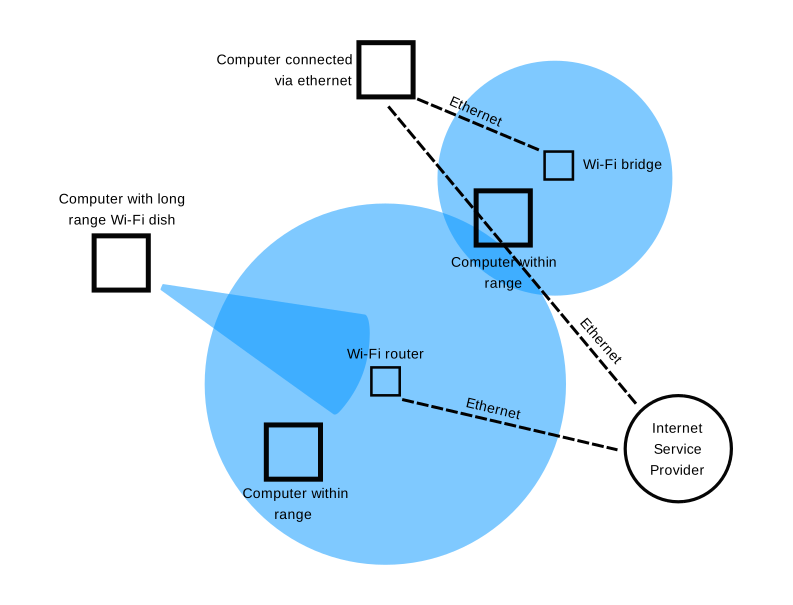
Public Wi-Fi operates by leveraging wireless access points (APs) that broadcast a Wi-Fi signal. These APs are connected to a router, which in turn is linked to a broadband internet service provider (ISP). When a user's device, such as a smartphone or laptop, is within range, it can detect the Wi-Fi network's SSID (Service Set Identifier) and attempt to connect. Depending on the network's configuration, connection might be immediate, require a password, or necessitate accepting terms of service via a captive portal login page. This captive portal often serves as a gateway, sometimes displaying advertisements or requiring user authentication before granting full internet access. The underlying technology relies on radio waves operating on specific frequencies, primarily 2.4 GHz and 5 GHz, managed by the IEEE 802.11 standards.
📊 Key Facts & Numbers
The scale of public Wi-Fi is staggering. In the United States alone, over 80% of coffee shops offer free Wi-Fi, and airports worldwide provide access to millions of travelers daily. The market for public Wi-Fi services is valued in the billions of dollars, driven by advertising revenue, subscription fees, and the indirect economic benefits of increased foot traffic for businesses. A significant portion of mobile internet usage, particularly in urban areas, occurs over public Wi-Fi networks, reducing reliance on costly cellular data plans for many users. For instance, a single Starbucks location can serve hundreds of users concurrently, demonstrating the high-density capacity of these networks.
👥 Key People & Organizations
While no single individual can be credited with inventing public Wi-Fi, several organizations and companies have been instrumental in its development and widespread adoption. The Wi-Fi Alliance, established in 1999, plays a crucial role in certifying interoperability and promoting the Wi-Fi standard. Early commercial hotspot providers like Wayport (founded by Dave Vadas) and The Coffee Connection were key in demonstrating the business viability of public Wi-Fi. Major telecommunications companies and internet service providers, such as Comcast (with its Xfinity Wi-Fi network) and AT&T, have invested heavily in building out extensive public Wi-Fi infrastructures. Retail giants like Starbucks and McDonald's have also become de facto public Wi-Fi providers, offering access to millions of customers daily, significantly shaping the user experience and accessibility of these networks.
🌍 Cultural Impact & Influence
Public Wi-Fi has fundamentally reshaped social interaction and consumer behavior. It has transformed public spaces like libraries and cafes into de facto co-working environments, fostering a culture of 'digital nomadism' and remote work. The ubiquity of free internet access has democratized information, enabling individuals without home broadband to access educational resources, job opportunities, and essential online services. For businesses, public Wi-Fi has become a critical customer acquisition and retention tool, driving foot traffic and providing valuable customer data through captive portals. Culturally, it has normalized the expectation of constant connectivity, influencing everything from how we navigate cities to how we consume media on the go. The rise of social media platforms like Instagram and TikTok has been intrinsically linked to the widespread availability of public Wi-Fi, allowing for real-time sharing and engagement from virtually any location.
⚡ Current State & Latest Developments
The public Wi-Fi landscape is continuously evolving, driven by technological advancements and shifting user demands. The rollout of Wi-Fi 6 (802.11ax) and the upcoming Wi-Fi 7 standards promise faster speeds, lower latency, and improved capacity, especially in crowded environments. Many municipalities and transit authorities are expanding free public Wi-Fi initiatives to enhance digital inclusion and smart city infrastructure. For instance, cities like New York City have been working to expand free Wi-Fi kiosks through programs like LinkNYC. Furthermore, the integration of Wi-Fi with 5G cellular networks is creating more seamless and robust connectivity options. Security remains a paramount concern, leading to increased adoption of WPA3 encryption and the promotion of Virtual Private Network (VPN) usage among public Wi-Fi users.
🤔 Controversies & Debates
The most persistent controversy surrounding public Wi-Fi centers on security. Concerns about data privacy are rampant, as network operators, including businesses and ISPs, can potentially monitor user activity. The ethical implications of data collection and targeted advertising through captive portals are also debated. Another point of contention is the digital divide; while public Wi-Fi aims to bridge this gap, the quality and availability can be inconsistent, particularly in rural or underserved areas, leading to disparities in access. The debate over whether public Wi-Fi should be treated as a public utility, akin to water or electricity, continues in various policy circles.
🔮 Future Outlook & Predictions
The future of public Wi-Fi is likely to be characterized by greater integration, enhanced security, and expanded accessibility. We can anticipate a surge in Wi-Fi 7 deployments, offering multi-gigabit speeds and significantly improved network efficiency. The concept of 'smart cities' will increasingly rely on robust public Wi-Fi networks to power IoT devices, manage traffic, and deliver public services. Security protocols are expected to become more sophisticated, with WPA3 becoming the standard and greater emphasis placed on user education regarding VPNs and safe browsing habits. Furthermore, public Wi-Fi may evolve beyond simple internet access, potentially incorporating augmented reality overlays or location-based services delivered directly through the network. The ongoing competition between cellular data providers and Wi-Fi providers will continue to shape pricing models and service offerings, potentially leading to more bundled solutions.
💡 Practical Applications
Public Wi-Fi's practical applications are vast and deeply embedded in daily life. For travelers, it's an essential tool for navigation, booking accommodations, and staying connected with loved ones while in airports, hotels, and train stations. In educational settings, libraries and universities provide free Wi-Fi to students and faculty, facilitating research and online learning. Retail businesses use it to attract customers, offer loyalty programs, and gather insights into consumer behavior. Public Wi-Fi is also crucial for emergency services and dis
Key Facts
- Category
- technology
- Type
- topic