
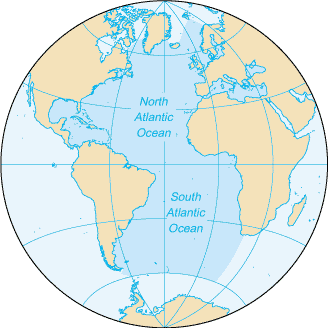
Contents
Overview
The South Atlantic Ocean's geological genesis is tied to the breakup of the supercontinent Pangaea approximately 180 million years ago, a process that began to rift South America away from Africa. This continental drift opened the basin, gradually expanding it over millions of years. Early human interaction was limited, with indigenous populations along the coasts having localized maritime knowledge. However, its historical significance exploded with the Age of Discovery, particularly after Christopher Columbus's 1492 voyage, which opened the Americas to European exploration. The Portuguese, under explorers like Vasco da Gama, were instrumental in charting routes around Africa and into the South Atlantic, establishing trade networks that would define global commerce for centuries. The ocean became a central stage for the transatlantic slave trade, a brutal chapter that forcibly moved millions of Africans to the Americas, fundamentally reshaping societies on both sides of the ocean. The Royal Navy's dominance in the 19th century further cemented the South Atlantic's role as a strategic maritime zone.
⚙️ How It Works
The South Atlantic Ocean functions as a massive engine for global climate and oceanic circulation. Its defining feature is the South Atlantic Gyre, a large system of rotating ocean currents driven by prevailing winds and the Coriolis effect. This gyre plays a critical role in heat distribution, transporting warm equatorial waters southward and cooler waters northward. The Brazil Current brings warm, saline water down the coast of South America, while the Benguela Current brings cold, nutrient-rich waters up the coast of Africa, supporting abundant marine ecosystems. The ocean floor is characterized by the Mid-Atlantic Ridge, a vast underwater mountain range where new oceanic crust is formed through volcanic activity. Deep ocean trenches, such as the South Sandwich Trench, also mark its abyssal plains, contributing to its complex bathymetry and hydrological dynamics.
📊 Key Facts & Numbers
The South Atlantic Ocean covers an estimated 85 million square kilometers of the Earth's surface, representing a substantial portion of the total Atlantic Ocean. Its deepest point is the South Sandwich Trench. The ocean's volume is approximately 280 million cubic kilometers, holding about 7% of the world's total ocean water. Annually, it hosts an estimated 1.5 billion metric tons of phytoplankton biomass, forming the base of its rich food web. Over 70% of global container ship traffic passes through its waters, carrying an estimated $1.5 trillion worth of goods annually. The Exclusive Economic Zones bordering the South Atlantic contain an estimated 15% of the world's undiscovered oil and gas reserves.
👥 Key People & Organizations
Key figures in the exploration and understanding of the South Atlantic include Portuguese navigators like Bartolomeu Dias, who first rounded the Cape of Good Hope in 1488, and Ferdinand Magellan, whose expedition in the early 16th century first circumnavigated the globe, largely through the South Atlantic and Pacific. Scientific institutions like the National Oceanography Centre in the UK and Brazil's Federal University of Rio de Janeiro conduct vital research on its currents, ecosystems, and geology. Organizations such as the International Maritime Organization (IMO) set regulations for shipping traffic, while the International Seabed Authority oversees resource exploration in international waters. The United Nations Environment Programme (UNEP) also plays a role in coordinating conservation efforts for its marine biodiversity.
🌍 Cultural Impact & Influence
The South Atlantic Ocean has been a crucible for global cultural exchange and historical development. It served as the primary route for the Columbian Exchange, introducing new species, technologies, and diseases between the Old and New Worlds, with profound demographic and societal impacts. The forced migration of enslaved Africans across its waters during the transatlantic slave trade profoundly shaped the cultures, music, and demographics of Brazil, the Caribbean, and parts of North America. Its strategic importance during periods of colonial expansion and global conflict, such as World War II naval battles, has been depicted in countless historical accounts and films. The ocean's influence is also evident in the cuisines, languages, and artistic expressions of coastal nations, reflecting centuries of interaction and shared history.
⚡ Current State & Latest Developments
In 2024, the South Atlantic Ocean is experiencing significant shifts due to climate change. Rising sea temperatures are impacting marine ecosystems, leading to changes in fish migration patterns and coral reef health. The IPCC reports indicate an increase in the frequency and intensity of extreme weather events, affecting coastal communities and maritime operations. Efforts are underway to expand marine protected areas, with initiatives like the establishment of the South Atlantic Marine Protected Area network aiming to conserve biodiversity. New deep-sea exploration technologies are revealing previously unknown species and geological formations, while the development of offshore renewable energy sources, such as wind and tidal power, is gaining momentum. The ongoing debate over deep-sea mining also presents a critical development for the region's future.
🤔 Controversies & Debates
The South Atlantic Ocean is a focal point for several ongoing controversies. The most significant is the debate surrounding deep-sea mining for polymetallic nodules, which proponents argue could provide crucial minerals for the green energy transition, while critics, including organizations like the World Wildlife Fund (WWF), warn of irreversible damage to fragile, poorly understood ecosystems. The impact of plastic pollution on marine life and the food chain remains a persistent concern, with vast garbage patches forming within its gyres. Overfishing of key commercial species, such as Atlantic bluefin tuna and Argentine red shrimp, is another major point of contention, leading to calls for stricter international quotas and enforcement by bodies like the Food and Agriculture Organization (FAO). The geopolitical implications of increased maritime traffic and resource competition also contribute to tensions.
🔮 Future Outlook & Predictions
The future of the South Atlantic Ocean is intrinsically linked to global climate action and sustainable resource management. Projections suggest continued warming and potential shifts in major current systems, which could have far-reaching consequences for global weather patterns and marine productivity. The expansion of offshore renewable energy infrastructure, particularly wind farms, is likely to increase, potentially creating new artificial reefs but also posing risks to migratory species. The ongoing development of international frameworks for managing deep-sea resources will be critical in determining whether the ocean floor faces exploitation or preservation. Advances in artificial intelligence and remote sensing are expected to improve our ability to monitor and understand its complex dynamics, potentially aiding in conservation and disaster response efforts.
💡 Practical Applications
The South Atlantic Ocean serves as a vital highway for global commerce, with major shipping routes connecting Europe, Africa, and South America. It is a critical source of fisheries, supporting economies and food security for coastal nations, with key catches including sardines, mackerel, and various species of hake. The ocean floor holds significant reserves of oil and nat
Key Facts
- Category
- nature
- Type
- topic