
Contents
Overview
The conceptual roots of thermohaline circulation trace back to early oceanographic observations. Explorers like Sir Charles Wyville Thomson aboard the HMS Challenger (1872-1876) provided foundational data on ocean depths and water properties, hinting at large-scale movements. Early theoretical frameworks were proposed by scientists such as Otto Krümmel in the 1880s, who recognized the role of density differences. However, it was Henry Stommel in the mid-20th century who significantly advanced the quantitative understanding of deep ocean circulation, proposing models that linked density-driven flows to global heat distribution. His seminal 1957 paper in Tellus laid much of the groundwork for modern THC research, distinguishing it from wind-driven surface currents and emphasizing its role in global heat transport. The term 'thermohaline' itself, combining 'thermo' (heat) and 'haline' (salt), was popularized to capture the dual drivers of density change.
⚙️ How It Works
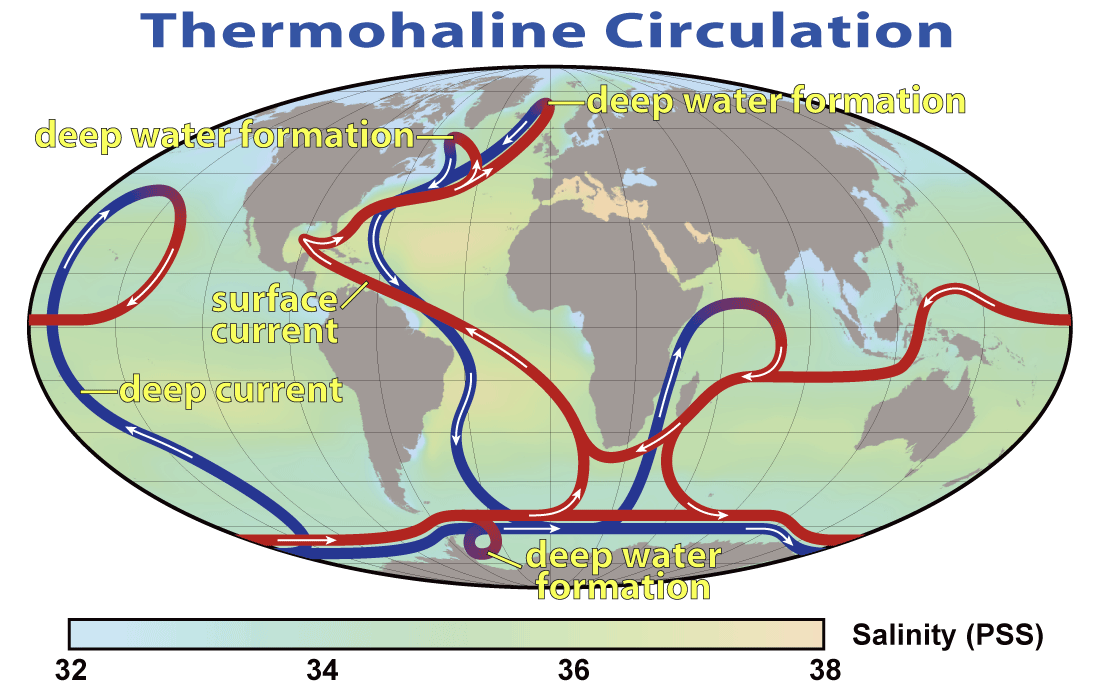
Thermohaline circulation operates on a principle of density-driven flow. Surface waters in high-latitude regions, particularly the North Atlantic near Greenland and the Norwegian Sea, lose heat to the atmosphere and become colder. Simultaneously, evaporation can increase salinity, while ice formation expels salt, further concentrating it in the remaining liquid water. These processes make the surface water denser than the surrounding ocean. When this dense water becomes heavy enough, it sinks, initiating the formation of deep water masses like the North Atlantic Deep Water (NADW). This sinking pulls more surface water from lower latitudes to replace it, creating a continuous flow. The deep water then travels southward, eventually upwelling in various parts of the world's oceans, most significantly in the Southern Ocean, after a journey that can take centuries. This global circuit is crucial for redistributing heat, sequestering atmospheric CO2, and oxygenating the deep sea.
📊 Key Facts & Numbers
The sheer scale of thermohaline circulation is staggering. The North Atlantic Deep Water (NADW) formation alone transports approximately 15-20 Sverdrups (Sv) of water, where 1 Sv equals one million cubic meters per second. The entire global THC system is estimated to move around 20-30 Sv. This circulation plays a pivotal role in global heat distribution, with the Gulf Stream, a surface component often linked to THC, transporting an estimated 1.4 petawatts of heat, equivalent to about 100 times the world's electricity generation. The transit time for water to complete a full cycle through the THC can range from 500 to 2000 years, with the oldest waters found in the North Pacific having a mean age of approximately 1000 years. The THC is responsible for transporting about 40% of the heat absorbed by the oceans from the tropics towards the poles. Changes in salinity of just 1% can alter water density by about 0.5 kg/m³, enough to influence deep water formation.
👥 Key People & Organizations
Key figures in understanding thermohaline circulation include Henry Stommel, whose theoretical work in the 1950s and 1960s was foundational. Walter Munk also made significant contributions to understanding ocean mixing and circulation dynamics. More recently, Syukuro Manabe and Klaus Hasselmann, Nobel laureates in Physics (2021), developed climate models that incorporated ocean circulation, including THC, to simulate global climate change. Major research institutions like the Woods Hole Oceanographic Institution (WHOI) and the Scripps Institution of Oceanography are at the forefront of observational and modeling studies. International collaborations, such as the World Climate Research Programme (WCRP), coordinate global efforts to monitor and understand the THC's behavior and its response to climate change.
🌍 Cultural Impact & Influence
Thermohaline circulation's influence extends far beyond oceanography, shaping global climate and weather patterns that have profoundly impacted human history and culture. For instance, the relative warmth of Western Europe, compared to other regions at similar latitudes, is largely attributed to the heat transported by the Gulf Stream and its extension, the North Atlantic Drift, which are surface manifestations of the larger THC system. This moderating effect has historically enabled agriculture and settlement in regions that might otherwise be too cold. The potential for THC to weaken or shut down, as suggested by paleoclimate evidence from Ice Ages, has become a recurring theme in climate change discourse, fueling anxieties about abrupt and severe climatic shifts. Its depiction in popular culture, often as a dramatic climate tipping point, highlights its perceived power and mystery.
⚡ Current State & Latest Developments
Current research on thermohaline circulation is intensely focused on its stability and potential response to anthropogenic climate change. Observations from oceanographic buoys, research vessels, and satellite data indicate a potential weakening of the Atlantic Meridional Overturning Circulation (AMOC), a key component of the THC, over the past few decades. Studies published in journals like Nature Climate Change and Science suggest that increased freshwater input from melting Greenland ice and Arctic sea ice could reduce surface water salinity in the North Atlantic, thereby decreasing its density and potentially inhibiting deep water formation. This slowdown could have far-reaching consequences, including altered precipitation patterns, sea-level rise along the U.S. East Coast, and colder winters in Europe. The precise rate and magnitude of this potential weakening remain subjects of active debate and ongoing research.
🤔 Controversies & Debates
The primary controversy surrounding thermohaline circulation centers on the timing and severity of potential future changes, particularly the weakening or collapse of the AMOC. While paleoclimate records, such as those from ice cores dating back thousands of years, clearly show past abrupt climate shifts linked to THC disruptions (e.g., the Younger Dryas event), predicting the exact timing for a future collapse is highly uncertain. Some climate models predict a significant weakening by the end of the 21st century, while others suggest a more gradual slowdown. Skeptics sometimes point to the inherent complexity and vast timescales involved, arguing that current observational data is insufficient to make definitive predictions about imminent collapse. The debate also touches on the efficacy of carbon sequestration through deep ocean currents and the potential for unintended consequences from geoengineering proposals aimed at counteracting global warming.
🔮 Future Outlook & Predictions
The future outlook for thermohaline circulation is a critical area of climate science, with projections pointing towards continued weakening of the AMOC under scenarios of unabated greenhouse gas emissions. Models suggest that by 2100, the AMOC could weaken by 30-50% compared to pre-industrial levels, though some studies indicate a potential for a more abrupt shutdown if certain tipping points are crossed. Such a weakening would lead to significant regional climate changes, including a cooling trend in northwestern Europe, altered rainfall patterns in the tropics, and accelerated sea-level rise along the Atlantic coast of North America. Conversely, aggressive mitigation of greenhouse gas emissions could stabilize or even partially reverse some of these trends, though the ocean's inertia means that past emissions will continue to influence THC for centuries. Research is ongoing to refine these projections and better understand the thresholds for abrupt changes.
💡 Practical Applications
Thermohaline circulation's primary 'application' is its fundamental role in regulating Earth's climate and distributing heat. However, understanding its dynamics has practical implications for climate modeling and forecasting. Accurate THC models are essential for predicting future climate
Key Facts
- Category
- science
- Type
- topic