
Contents
Overview
The conceptual seeds of vector graphics were sown long before digital computers, with early forms of geometric drawing and drafting. However, the true digital genesis arrived with early computer graphics systems in the 1950s and 1960s. Ivan Sutherland's groundbreaking Sketchpad program, developed at MIT, is widely considered a foundational precursor, demonstrating interactive graphical manipulation using light pens and mathematical descriptions. This era also saw the development of specialized vector display hardware, like the Tektronix 4010 terminal, which rendered images using electron beams tracing lines on a screen, rather than a fixed pixel grid. Early CAD systems, such as AutoCAD and CATIA, further solidified the importance of vector-based geometry for precision engineering and design.
⚙️ How It Works
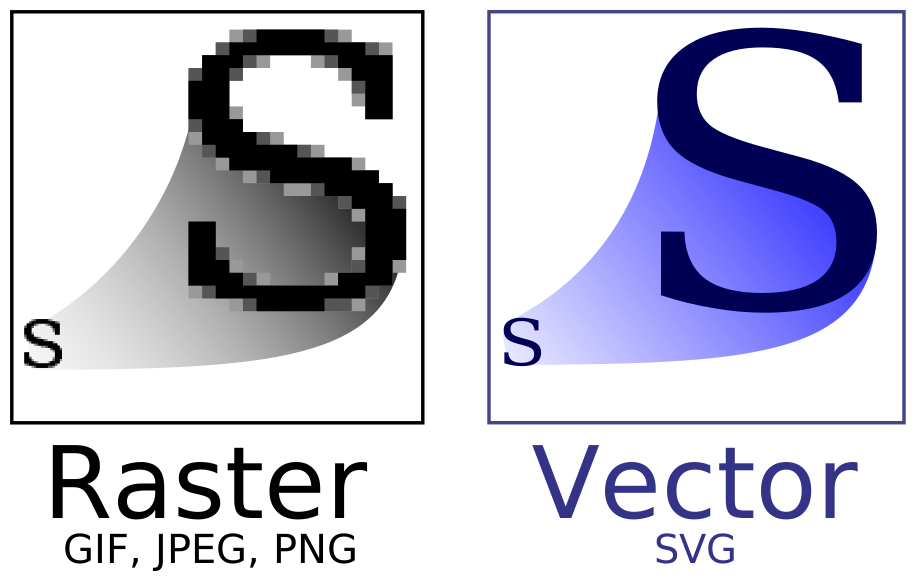
At its core, vector graphics relies on mathematical equations to define visual elements. Instead of storing color information for each pixel, vector files store instructions: 'draw a line from point A to point B with this color and thickness,' or 'create a circle with this radius and fill it with this gradient.' These instructions are based on geometric primitives: points, lines, Bezier curves (defined by anchor points and control handles), and polygons. When a vector image is displayed or rendered, the software interprets these mathematical descriptions and calculates the precise pixel placement for the output device, ensuring that resizing the image simply recalculates these equations, rather than stretching pixel data. This process is fundamentally different from raster graphics, which are composed of a grid of pixels, where scaling up leads to pixelation.
📊 Key Facts & Numbers
The Scalable Vector Graphics (SVG) format, developed by the World Wide Web Consortium (W3C), has become the de facto standard for web-based vector imagery. Adobe's Adobe Illustrator software has sold tens of millions of copies globally. Companies like Autodesk and Dassault Systèmes dominate the CAD software space, with millions of engineers and designers relying on their vector-based tools daily.
👥 Key People & Organizations
Key figures in the development of vector graphics include Ivan Sutherland, the 'father of computer graphics,' for his Sketchpad system. Early pioneers in CAD software include Michael J. Riddle, founder of Autodesk, and Francis Bernard and Jean-Pierre Marrigues, who developed CATIA. In the realm of graphic design software, Adobe's co-founders, John Warnock and Charles Geschke, were instrumental in developing PostScript, a page description language that heavily influenced vector file formats like Encapsulated PostScript (EPS) and Adobe Illustrator. The World Wide Web Consortium (W3C) played a crucial role in standardizing Scalable Vector Graphics for the web.
🌍 Cultural Impact & Influence
Vector graphics have profoundly shaped visual communication and digital art. Logos for major corporations like IBM, Google, and Nike are almost universally designed as vectors, ensuring consistent branding across all media, from business cards to billboards. The precision of vector graphics is essential for technical illustration, architectural blueprints, and cartography, enabling clear and accurate representation of complex data. The rise of web design and user interface (UI) development has further amplified the importance of SVG, allowing for responsive and sharp graphics on any screen resolution. This has led to a cultural shift where crisp, scalable visuals are expected, contributing to a higher overall standard for digital aesthetics.
⚡ Current State & Latest Developments
The current landscape of vector graphics is robust, driven by advancements in software and web technologies. Scalable Vector Graphics continues to gain traction on the web, with ongoing efforts by the World Wide Web Consortium (W3C) to expand its capabilities, including animation and interactivity. Adobe Illustrator remains the industry-standard professional tool, while more accessible alternatives like Affinity Designer and Inkscape (an open-source option) offer powerful vector creation capabilities. The integration of vector capabilities into 3D modeling and game development pipelines is also a significant trend, allowing for more efficient asset creation and rendering. Furthermore, AI-powered tools are beginning to assist in vector creation and manipulation, promising new workflows.
🤔 Controversies & Debates
A persistent debate centers on the choice between vector and raster graphics. While vectors excel at scalability and sharp lines, they can struggle to represent the subtle tonal gradations and complex textures found in photographs or detailed digital paintings, where raster formats like JPEG and PNG are superior. Some argue that the increasing complexity of vector rendering engines and the ubiquity of high-resolution displays blur the lines, making the distinction less critical for casual users. Another point of contention is the proprietary nature of some vector file formats, like Adobe Illustrator's AI format, versus the open standards like SVG, raising concerns about long-term accessibility and interoperability. The computational cost of rendering complex vector paths can also be a performance bottleneck in certain applications.
🔮 Future Outlook & Predictions
The future of vector graphics appears to be one of deeper integration and enhanced capabilities. We can expect further advancements in AI-assisted vector creation, potentially automating complex illustration tasks and generating intricate patterns. The expansion of SVG's capabilities, particularly in animation and 3D integration, will likely lead to more dynamic and interactive web experiences. The development of more efficient vector rendering engines could see their use expand into areas currently dominated by raster graphics, especially in augmented reality (AR) and virtual reality (VR) applications where precise geometric data is paramount. Furthermore, the ongoing push for open standards will likely ensure SVG's continued dominance as the universal vector format for the web and beyond.
💡 Practical Applications
Vector graphics are indispensable across numerous industries. In graphic design, they are the backbone for logos, icons, typography, and illustrations, ensuring brand consistency and sharp visuals. Web design heavily relies on SVG for responsive icons, interactive elements, and animated graphics. Computer-aided design (CAD) software, such as AutoCAD and SolidWorks, uses vector principles for engineering, architecture, and product design, enabling precise blueprints and 3D models. Geographic information systems (GIS) use vector data to represent features like roads, borders, and land parcels. Even in animation, vector-based software like Adobe Animate allows for smooth, scalable character movement and effects.
Key Facts
- Category
- technology
- Type
- concept