
Contents
- 🎵 Origins & History
- ⚙️ How It Works
- 📊 Key Facts & Numbers
- 👥 Key People & Organizations
- 🌍 Cultural Impact & Influence
- ⚡ Current State & Latest Developments
- 🤔 Controversies & Debates
- 🔮 Future Outlook & Predictions
- 💡 Practical Applications
- 📚 Related Topics & Deeper Reading
- Frequently Asked Questions
- References
- Related Topics
Overview
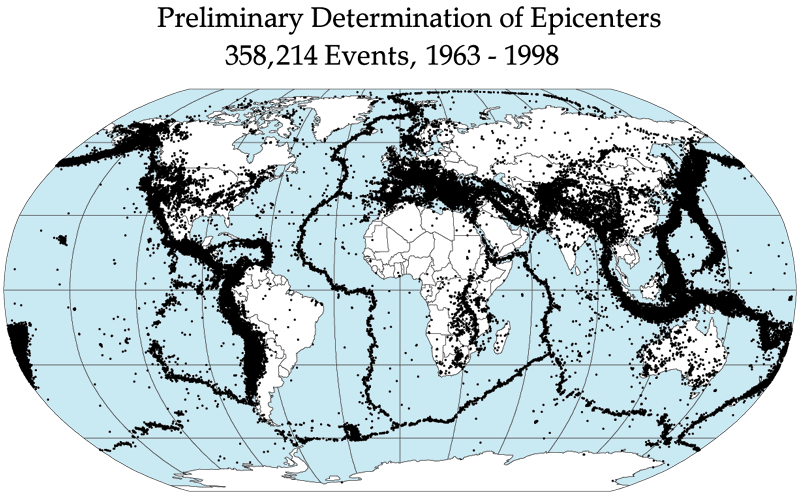
The study of earthquakes, seismology, has roots stretching back millennia, with early observations recorded in ancient China as early as 132 AD by Zhang Heng, who invented the first seismoscope. However, the scientific understanding of seismic waves and plate tectonics, the primary driver of most earthquakes, is a much more recent development. Key figures like Alfred Wegener proposed continental drift in 1912, laying groundwork for the theory of plate tectonics, which was solidified by geophysicists such as Harry Hess and Robert Dietz in the 1960s. The establishment of global seismic monitoring networks, like the WWSSN in the 1960s, revolutionized our ability to detect and analyze earthquakes worldwide.
⚙️ How It Works
Earthquakes occur when stress builds up along faults, which are fractures in the Earth's crust. This stress, often accumulated over decades or centuries due to the movement of tectonic plates, eventually exceeds the strength of the rocks, causing them to rupture. The sudden release of this stored energy propagates outward as seismic waves: P-waves (primary waves) and S-waves (secondary waves) travel through the Earth's interior, while surface waves cause the most damage at the Earth's surface. The point within the Earth where the rupture begins is called the hypocenter, and the point directly above it on the surface is the epicenter. The magnitude of an earthquake is a measure of the energy released, typically quantified by the Moment Magnitude Scale (Mw).
📊 Key Facts & Numbers
Globally, an estimated 500,000 detectable earthquakes occur each year, with about 100,000 of those strong enough to be felt. The most powerful recorded earthquake was the 1960 Valdivia earthquake in Chile, with a magnitude of 9.5 Mw. The 2004 Indian Ocean earthquake generated a tsunami that killed an estimated 230,000 people across 14 countries, highlighting the devastating secondary effects. The United States experiences around 13,000 earthquakes annually, with California being the most seismically active state, accounting for roughly 90% of U.S. seismic activity, though Alaska experiences the most powerful quakes. The cost of earthquake damage globally runs into billions of dollars annually, with the 1995 Kobe earthquake causing an estimated $100 billion in damages.
👥 Key People & Organizations
Key individuals in seismology include Charles Richter, who developed the magnitude scale bearing his name in 1935, and Jelly Legg, a pioneer in seismic wave analysis. Major organizations dedicated to earthquake research and hazard mitigation include the USGS, which operates a vast network of seismic stations, and the Global Earthquake Model Foundation, a non-profit organization focused on seismic risk assessment. The International Union of Geodesy and Geophysics (IUGG) also plays a crucial role in coordinating international research efforts in seismology and related fields.
🌍 Cultural Impact & Influence
Earthquakes have profoundly shaped human civilization, influencing settlement patterns, architecture, and cultural narratives. The fear and awe inspired by these events have led to their incorporation into mythology and religion across cultures, from the subterranean battles of Namazu in Japanese folklore to the wrath of Poseidon in Greek mythology. Modern society grapples with earthquake impacts through engineering innovations like base isolation systems and seismic retrofitting of buildings, as seen in cities like Tokyo and Los Angeles. The development of early warning systems, such as ShakeAlert in the U.S., represents a significant step in mitigating human and economic losses.
⚡ Current State & Latest Developments
The ongoing challenge in earthquake science is improving the accuracy and lead time of earthquake prediction, a goal that remains elusive. Current research focuses on refining seismic monitoring with advanced sensor technologies, including fiber optic sensing and distributed acoustic sensing. Efforts are also underway to better understand earthquake triggering mechanisms, particularly in areas with induced seismicity from activities like fracking and wastewater injection. The development of AI and machine learning algorithms for analyzing seismic data is also a rapidly advancing frontier, promising more sophisticated hazard assessments. The 2023 Turkey–Syria earthquakes served as a stark reminder of the devastating potential and the urgent need for continued research and preparedness.
🤔 Controversies & Debates
A significant debate revolves around the possibility and ethics of earthquake prediction. While some researchers claim progress in forecasting probabilities for specific regions, a reliable method for predicting the exact time, location, and magnitude of a major earthquake remains unproven, leading to skepticism from many in the scientific community. Another controversy surrounds induced seismicity, with ongoing legal and scientific disputes over the link between oil and gas extraction activities, particularly wastewater disposal wells, and increased earthquake frequency in regions like Oklahoma. The allocation of resources for earthquake preparedness versus other societal needs also presents an ongoing ethical and political debate.
🔮 Future Outlook & Predictions
The future of earthquake science lies in integrating diverse data streams and advanced computational models. Researchers are exploring the potential of using machine learning to identify subtle precursory signals in seismic data, potentially leading to more accurate short-term forecasts. The development of 'smart' infrastructure that can self-monitor and report seismic activity in real-time is also on the horizon. Furthermore, a deeper understanding of fault mechanics and the role of fluids in triggering earthquakes could lead to novel mitigation strategies, though the prospect of 'earthquake control' remains highly speculative and is largely confined to science fiction. The focus will likely remain on enhancing resilience and preparedness through better building codes and early warning systems.
💡 Practical Applications
Understanding earthquakes has direct practical applications in engineering, urban planning, and emergency management. Seismic hazard maps, developed by organizations like the Geological Survey of Canada, guide building codes and land-use zoning to minimize risk in earthquake-prone areas. Early warning systems, such as Japan's EEW, provide crucial seconds to minutes of advance notice, allowing for automated shutdowns of critical infrastructure like Shinkansen trains and industrial facilities. Seismological data is also vital for resource exploration, particularly in identifying underground geological structures relevant to oil, gas, and geothermal energy extraction, though this can also lead to induced seismicity concerns.
Key Facts
- Year
- Ongoing
- Origin
- Global
- Category
- nature
- Type
- phenomenon
Frequently Asked Questions
What causes an earthquake?
Earthquakes are primarily caused by the sudden release of energy stored in the Earth's crust. This energy builds up over time due to the movement of tectonic plates. When the stress along a fault line exceeds the rock's strength, it ruptures, sending out seismic waves that shake the ground. While most earthquakes are natural, human activities like fracking, mining, and the filling of large reservoirs can also induce seismic activity by altering underground pressures.
How are earthquakes measured?
Earthquakes are measured using magnitude scales, the most common being the Moment Magnitude Scale (Mw). This scale quantifies the total energy released by an earthquake, based on seismic waves, the area of fault rupture, and the amount of slip. Older scales like the Richter scale are still sometimes mentioned but are less accurate for larger quakes. Intensity scales, like the Modified Mercalli Intensity Scale, describe the effects of an earthquake at a specific location, based on observed damage and human reactions.
Can earthquakes be predicted?
Currently, there is no scientifically proven method to predict the exact time, location, and magnitude of a major earthquake. While seismologists can identify regions at high risk and estimate the probability of future earthquakes over long periods (e.g., decades), precise short-term prediction remains elusive. Research into potential precursors, such as changes in ground deformation or seismic wave velocities, is ongoing, but these methods have not yet yielded reliable predictive capabilities. The focus remains on preparedness and early warning systems.
What is the difference between an epicenter and a hypocenter?
The hypocenter, also known as the focus, is the actual point within the Earth where the earthquake rupture begins. It's the source of the seismic waves. The epicenter, on the other hand, is the point on the Earth's surface directly above the hypocenter. When news reports mention an earthquake's location, they are typically referring to the epicenter, as it's the point closest to us on the surface and often where the most direct damage is observed.
What are the most dangerous types of seismic waves?
While all seismic waves contribute to shaking, surface waves are generally responsible for the most significant damage during an earthquake. These waves travel along the Earth's surface and are slower than body waves (P-waves and S-waves) but have larger amplitudes. There are two main types of surface waves: Love waves, which cause horizontal shearing, and Rayleigh waves, which cause both vertical and horizontal motion, resembling ocean waves. These motions can cause buildings to sway violently, leading to structural collapse.
How can I prepare for an earthquake?
Preparing for an earthquake involves several key steps. Secure heavy furniture, appliances, and water heaters to walls to prevent them from falling. Store heavy items on lower shelves. Identify safe places in each room, such as under a sturdy table or desk, and practice Drop, Cover, and Hold On drills. Assemble an emergency kit with water, non-perishable food, a first-aid kit, flashlight, batteries, and any necessary medications. Develop a family communication plan and know how to shut off utilities like gas and water if necessary. In earthquake-prone regions, consider retrofitting your home for seismic resistance.
What is induced seismicity?
Induced seismicity refers to earthquakes that are caused by human activities, rather than natural geological processes. Common causes include the injection of fluids deep underground, such as during fracking operations or wastewater disposal wells associated with oil and gas extraction. Other activities like mining, reservoir impoundment, and underground nuclear testing can also trigger earthquakes. While typically smaller than major natural earthquakes, induced seismic events can still cause damage and concern in populated areas.